1

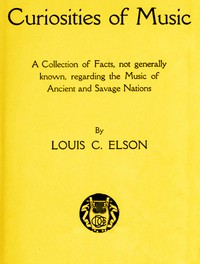
Curiosities of Music: A Collection of Facts not generally known, regarding the Music of Ancient and Savage Nations — Background and Themes
(0 User reviews)
2039
Project Gutenberg
2021
Not confirmed
Music -- History and criticism
Readers of public-domain and historical texts
Project Gutenberg digital edition
en
Edition facts
Words
89,879
Reading time
391 min
Text sections
14
Curiosities of Music: A Collection of Facts not generally known, regarding the Music of Ancient and Savage Nations — Background and Themes can be approached with a clearer sense of reading commitment from its source measurements: 89,879 words, 6 hr 31 min estimated reading time, and 14 detected text sections.
The text analysis averages about 25.4 words per sentence, while the detected sections provide another way to judge how the source is divided.
Project Gutenberg metadata also associates the work with “Music -- History and criticism,” connecting these edition facts with the source record’s subject description.
Source:
Project Gutenberg record #66216
Elson's 1880 collection of musical curiosities from ancient and non-Western cultures, drawing on period sources and personal commentary. The excerpts reveal a focus on Chinese and Japanese music, with observations on instruments, social roles, and cultural contradictions.
Editorial Edition Score
4.8/5
★★★★★
★★★★★
Calculated from edition completeness, EPUB availability, text structure and catalogue metadata. Not a user rating.
How this score is calculated
- Description quality20 pts
- Title & short description10 pts
- Source metadata20 pts
- Text length15 pts
- Chapters / structure15 pts
- EPUB file integrity20 pts
Total of 100 points, scaled to a 2.5-5.0 range. Editions with an empty description or a missing EPUB file are not scored.
Edition quality
Read the Text
CHAPTER I. INTRODUCTION.
Music has been broadly defined by Fetis as “the art of moving the feelings by combinations of sounds;” taken in this broad sense it may be considered as coeval with the human race.
Vocal music, in a crude form, is as natural in man, to express feelings, as it is for a cat to purr or a lion to roar; as regards instrumental music, the primitive man might have found in every hollow tree a reverberating drum, and in every conchshell or horn of cattle, the natural beginnings of instrumental music; we shall find later that many nations ascribe the discovery of their music to the accidental appliance of some natural instrument; our surest guide in watching the rise of the art, should be the manner in which savage peoples, yet in a state of nature, produce music, and we shall find too, that even the lowest in the scale, even those beings who make the monkey tribe nearer and dearer to us, as possible relatives (the bushmen of Australia for example), have still a method of “moving the feelings by means of combinations of sounds.”
It is therefore, really in barbarous nations, that we may, reasoning by analogy, find in what state music existed when our own ancestors were in a state of nature; but in order to give a more chronological character to our sketches we will begin with the _Music and Musical Mythology of the Ancients_.
With this people, and the Egyptians we find proofs of the existence of a musical system at a time which far antedates the earliest reliable Scriptural records.
Among the Hindoos especially, as far back as history extends, music has been treated not only as a fine art, but philosophically and mathematically. According to the oldest Brahminical records, in their all-embracing “Temple of Science,” it belongs to the 2d chief division of Lesser Sciences, but its natural and philosophic elements, are, with a nice distinction, admitted into their holiest and oldest book, the _Veda_.[1] Of course it has a divine origin ascribed to it, in fact the entire realm of Indian music is one tale of Mythology.
According to Brahminical accounts, when Brahma had lain in the egg three thousand billion, four hundred million of years (3,000,400,000,000) he split it by the force of his thought and made Heaven and Earth from the two pieces; then Manu brought forth ten great forces, which made Gods, Goddesses, good and evil spirits and Gandharbas (Genii of music), and Apsarasas (Genii of Dance), and these became the musicians of the Gods, before man knew of the art. Then Sarisvati, Goddess of Speech and Oratory, consort of Brahma, at Brahma’s command brought the art to man and gave him also his finest musical instrument, the Vina, of which hereafter. Music then found a protector in the demi-god Nared, one of the chief Indian musical deities, while Maheda Chrishna helped it along by allowing five keys, or modes, to spring from his head (_a la_ Minerva) in the shape of Nymphs, and his wife Parbuti, added one more; then Brahma added thirty lesser keys, or modes, and all these modes were also Nymphs.
The Hindoo scale has seven chief tones and these tones are represented as so many heavenly sisters.
In the Indian legends, music is represented as of immense might. All men, all animals, all inanimate nature listened to the singing of Maheda and Parbuti with ecstasy.
Some modes were never to be sung by mortals, as they were so fiery that the singer would be consumed by them. In the time of Akber, it is related, that ruler commanded Naik Gobaul, a famous singer, to sing the Raagni[2] of Fire; the poor singer entreated in vain, to be allowed to sing a less dangerous strain; then he plunged up to his neck in the river Djumna, and began: he had not finished more than half of his lay when the water around him began to boil; he paused (at boiling point) but the relentless, or curious Akber, demanded the rest, and with the end of the song the singer burst into flames and was consumed. Another melody caused clouds to rise and rain to fall; a female singer is said once to have saved Bengal from famine and drought in this manner. Another lay caused the sun to disappear and night to come at midday, or another could change winter to spring or rain to sunshine. All these typify beautifully the might of music with this race. Of the four chief tone systems, two also have divine origin, from Iswara and from Hanuman (the Indian Pan), the others come from Bharata Muni who invented the drama with music and dance, and from Calinath.
Louis C. Elson's Curiosities of Music (1880) opens with a preface explaining that the chapters originally appeared in a magazine, The Vox Humana, and were compiled to present “the most curious points in the music of many nations, ancient and modern.” The catalog subject is “Music – History and criticism,” but the excerpts show a narrower emphasis: detailed accounts of Chinese and Japanese music, with briefer treatments of other cultures. Elson does not claim comprehensive scholarship; he avoids “disputed points” such as Hebrew or Greek music as “too abstruse for periodical reading.” Instead, he seeks facts that would interest a general reader, and the resulting text is a blend of reported observation, cultural comparison, and personal judgment.
Chinese Music as a Series of Contradictions
Elson devotes multiple chapters to Chinese music, describing it as “a series of contradictions” that differ from Western norms. He lists contrasts: “We mourn in black, they in white; we respect crowns as badges of honor, they the boots; we build solid walls, they make them hollow.” In music, he notes that the Chinese place the orchestra behind the stage, whereas Western practice puts it in front. He also reports that children perform in troupes, beginning training very young, and that boat races feature “deafening music” with “the sonorous noise of the tum-tum” and a clarinet that gives “perpetually the same note.” Elson quotes a description of such an event, calling the resulting sound “infernal harmony.” These details illustrate his method: he relies on secondary accounts (often unattributed) and presents them as curiosities, while adding his own interpretive frame.
Japanese Music and the Role of Women
In the chapter on Japan, Elson observes that “the female sex are proficient in the art,” contrasting with Chinese custom. He notes that Japanese songs “do not appear to ha” (the excerpt cuts off), but he states that the Japanese musical system “has never been carefully formed or elucidated.” He compares Japanese and Chinese music, finding “many and irreconcilable” contradictions despite apparent affinity. Elson’s treatment of Japan is briefer than that of China, and he does not provide the same level of descriptive detail. The excerpts suggest that his interest lies more in cataloging differences than in systematic analysis. The incomplete sentence is a reminder that the digital text is a selection; the full chapter may contain further observations.
Elson’s Editorial Voice and Cultural Commentary
Throughout the excerpts, Elson interjects personal opinions and cultural judgments. Of China, he writes that its “heaviest drawbacks, in music, as well as in all civilization, seem to be, a senseless clinging to ancient usages; an education of the head, and not of the heart; an etiquette which becomes both ludicrous and burdensome.” He speculates on future progress, noting that Japan had recently made “giant strides” and that China might experience a similar awakening. These passages reveal Elson’s late-19th-century perspective: he treats non-Western music as exotic material for a Western audience, and he measures other cultures against Western norms. The book’s title promises “facts not generally known,” but the excerpts show that Elson’s facts are often filtered through his own biases and the limitations of his sources.
Readers should approach Curiosities of Music as a period document rather than a reliable survey. Elson’s reliance on magazine-length chapters and secondary sources means that his claims—especially about Chinese and Japanese music—should be verified against modern scholarship. The book is most valuable for what it reveals about 19th-century attitudes toward non-Western cultures and the state of musical knowledge at the time. The excerpts provide a starting point for comparing Elson’s descriptions with contemporary accounts.
I keep thinking about how Elson’s book treats old music as something alive, not just preserved—how those ancient chants and instruments still carry a pulse. It reminded me of turning through that old hymnal, where the same feeling lingers: voices finding shape across centuries. There’s a quiet comfort in that continuity. The St. Gregory Hymnal and Catholic Choir Book — Context and Discussion stayed with me the same way, like a familiar hush after singing.
There are no reviews for this eBook.
There are no comments for this eBook.
Reader reflection
How will you remember this book?
Save your reaction, strongest insight, and memorable passage.
Your progress
0
/
10
2
What was your overall reaction to the book?
3
Would you recommend this book to another reader?
4
Did the language feel accessible?
5
How understandable was the text?
6
How much did the book move you?
7
How useful did the reading feel?
8
How personally connected did you feel to the book?
9
What is the main idea you are taking away?
10