About 57 minutes
Sketch of a New Esthetic of Music — Story, Setting & Ideas
Music History
13,090 recorded words. 7 minutes difference from this book's estimate.
View Gutenberg source #31799
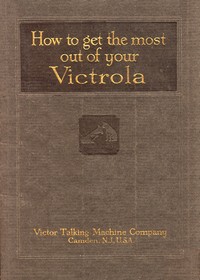
For How To Get the Most Out of Your Victrola — Background and Themes, the stored edition analysis reports 11,307 words, 50 min estimated reading time, and 10 detected text sections.
The text analysis averages about 26.4 words per sentence, while the detected sections provide another way to judge how the source is divided.
Project Gutenberg metadata also associates the work with “Music appreciation,” connecting these edition facts with the source record’s subject description.
Explore this collection
These alternatives are selected using recorded categories and estimated reading time.
About 57 minutes
Music History
13,090 recorded words. 7 minutes difference from this book's estimate.
View Gutenberg source #31799About 58 minutes
Music History
13,307 recorded words. 8 minutes difference from this book's estimate.
View Gutenberg source #10448About 36 minutes
Music History
8,057 recorded words. 14 minutes difference from this book's estimate.
View Gutenberg source #30412Search stored excerpts and compare books → Choose by your preferences →
Choices use stored catalog measurements. Estimates vary with reading speed. A shared category is a catalog label, not a claim that two books have the same argument or literary quality.
Search reads excerpt text stored with this catalog and links to its associated Gutenberg record. The connection is stored in the site database; this tool does not recheck that every excerpt is word-for-word identical to that external record. Excerpt search does not cover every chapter and does not verify historical publication dates.
Catalog snapshot checked: 2026-09-26. Coverage: 98 public books, 98 available source excerpts.
Calculated from edition completeness, EPUB availability, text structure and catalogue metadata. Not a user rating.
Total of 100 points, scaled to a 2.5-5.0 range. Editions with an empty description or a missing EPUB file are not scored.
Public-domain source text
The source text is kept in the dedicated reader, separate from this catalogue record and its commentary.
The Victor Talking Machine Company’s 1919 booklet opens by addressing the reader directly on the day the Victrola first enters the home, promising that the instrument can be made to “entertain, to console and to inspire.” The prose moves quickly from this greeting to a claim that Victor records capture “a moment of inspired achievement” from great artists, bringing the Metropolitan Opera House into the parlor. The booklet’s structure alternates between exhortatory paragraphs and lists of recommended recordings, creating a hybrid of instruction manual and sales pitch. The tone is earnest and elevated, treating the Victrola as a near-spiritual resource for “the daily round of irritating concerns and duties.”
The booklet repeatedly collapses the distance between professional concert spaces and the domestic interior. It asserts that the “atmosphere” of the Metropolitan Opera House is brought into the home, and that performances become “an integral part of your life” available at a moment’s notice. This spatial argument is reinforced by the catalog’s structure: a section on concert songs lists works such as “Voce di primavera” and “Le Nil” without explaining how a listener might approach them, assuming the Victrola itself supplies the necessary context. The text treats the machine as a transparent window onto the stage, never acknowledging the mediation of the horn or the acoustic limitations of the recording. The effect is to position the owner as a privileged audience member, bypassing the expense and inconvenience of live attendance.
A separate section on dance music begins with a physiological claim: “The impulse to dance is spontaneous. It is a manifestation of the joy o’ life that needs some more vigorous means of expression than is provided by speech.” The Victrola is presented as the ideal response to this impulse because it eliminates the need to “rent a hall, engage an orchestra and send out invitations.” The booklet emphasizes immediacy—dancing “when the inspiration seizes you”—and flexibility, noting that the same orchestra that plays in metropolitan cities can be summoned at home. The practical advice is minimal: roll back the rugs and dance. The recurring image of the floor as a stage, and the body as spontaneously responsive, reinforces the idea that the Victrola unlocks a natural, unmediated physical joy.
The booklet’s treatment of popular music reveals a careful negotiation between high and low. It acknowledges that simple, catchy tunes “supply a perfectly natural human need” and that their charm is real even if fleeting. The text defends popular music by arguing that “Beauty is only skin deep… that is plenty deep enough.” Yet the booklet also asserts that the Victor Company selects only the best from the mass of published music, acting as a gatekeeper. A striking image compares the plainsman in Texas to the office man on Broadway, both able to get “the music of the moment at the moment.” This geographic leveling is central to the booklet’s sales pitch: the Victrola collapses not only social distance but physical distance, making metropolitan currency available everywhere.
Near the end of the booklet, a section titled “The Lesser Instruments” acknowledges that human nature is “moody” and may suddenly center on an oboe solo or a concertina. The text calls these “musical hors d’oeuvre,” suggesting they are lighter, optional courses in a listening meal. This section is brief and lacks the detailed lists that accompany the opera and dance sections, perhaps because the catalog of such recordings was smaller. The phrasing reveals an assumption that the owner’s taste will be eclectic and that the Victrola should accommodate whims. The booklet does not prescribe a listening order; instead, it implies that the machine itself, with its ready access to a vast catalog, is the only tool needed to follow whatever mood arises.
The booklet’s recurring movement between grand claims of spiritual uplift and practical advice about rolling back rugs reveals a tension between the Victrola as an instrument of high art and as a tool for everyday pleasure. Readers should note how the text uses spatial language—bringing the opera house home, making the plainsman equal to the Broadway office man—to sell not just a machine but a new way of organizing domestic life around recorded sound. The lists of recommended recordings offer a period-specific glimpse into early twentieth-century taste, but the booklet’s real subject is the promise of immediate, effortless access to music of any kind.
Reading this Victrola pamphlet took me back to my grandmother’s parlor, the crank handle spinning before anyone spoke. It was all about how to listen, not just what. Later, Shakespeare and Music — Edition Insights gave me that same ache of a door opening onto a shared past. Both books feel like someone patiently handing me a key to rooms I didn't know existed. Quiet, settled wonder, then.
Answer a few questions and save a private reflection on this device.