About 200 minutes
The story of chamber music — Inside the Classic
Music History
45,993 recorded words. 1 minutes difference from this book's estimate.
View Gutenberg source #70203
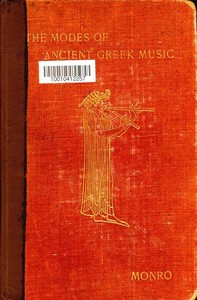
For The Modes of Ancient Greek Music — Reading Notes, the stored edition analysis reports 45,684 words, 3 hr 19 min estimated reading time, and 6 detected text sections.
The text analysis averages about 21.4 words per sentence, while the detected sections provide another way to judge how the source is divided.
Project Gutenberg metadata also associates the work with “Music, Greek and Roman,” connecting these edition facts with the source record’s subject description.
Explore this collection
These alternatives are selected using recorded categories and estimated reading time.
About 200 minutes
Music History
45,993 recorded words. 1 minutes difference from this book's estimate.
View Gutenberg source #70203About 193 minutes
Music History
44,387 recorded words. 6 minutes difference from this book's estimate.
View Gutenberg source #67545About 206 minutes
Music History
47,238 recorded words. 7 minutes difference from this book's estimate.
View Gutenberg source #23673Search stored excerpts and compare books → Choose by your preferences →
Choices use stored catalog measurements. Estimates vary with reading speed. A shared category is a catalog label, not a claim that two books have the same argument or literary quality.
Search reads excerpt text stored with this catalog and links to its associated Gutenberg record. The connection is stored in the site database; this tool does not recheck that every excerpt is word-for-word identical to that external record. Excerpt search does not cover every chapter and does not verify historical publication dates.
Catalog snapshot checked: 2026-09-26. Coverage: 98 public books, 98 available source excerpts.
Calculated from edition completeness, EPUB availability, text structure and catalogue metadata. Not a user rating.
Total of 100 points, scaled to a 2.5-5.0 range. Editions with an empty description or a missing EPUB file are not scored.
Public-domain source text
The source text is kept in the dedicated reader, separate from this catalogue record and its commentary.
Monro opens his 1894 monograph by positioning it as a sequel to his earlier article on Greek music in Smith's Dictionary of Greek and Roman Antiquities, where he first dissented from Westphal's widely accepted views on the ancient Modes. The preface reveals a work shaped by rapid archaeological discoveries: the Seikelos inscription from Tralles and a fragment of Euripides' Orestes appeared during writing, and just before publication, French excavators at Delphi uncovered a third-century BC hymn to Apollo. Monro delayed the book to incorporate this new material, acknowledging that such finds could transform the entire argument. The reader is thus encountering a study that consciously engages with the fluidity of evidence, where the author's thesis is presented as provisional, subject to the next papyrus or stone.
Monro's core argument hinges on a terminological fault line. Westphal and his followers held that Greek mode names (Dorian, Phrygian, etc.) indicated the position of a scale pattern on a fixed pitch grid—what Monro calls 'nomenclature by position.' Monro counters that Ptolemy's harmonic system, which reduced the keys from fifteen to seven, was an innovation that introduced this positional naming, and that earlier theorists like Aristoxenus used thesis differently. In a key passage, Monro dissects Aristoxenus's statement that melodic elements are 'limited and settled' in respect of dynameis, eidē, and theseis. He argues that thesis here refers to the relative placement of tetrachords (conjunct or disjunct), not to absolute pitch. Westphal, Monro claims, misread this technical vocabulary to support a modern theory. The debate is not merely philological: it determines whether ancient Greek music was perceived in terms of fixed pitch levels or movable patterns—a distinction with consequences for understanding the experience of melody.
A second battleground is Problem xix. 20, which discusses the special role of the Mesē (the middle note) in relation to the rest of the scale. Westphal interpreted this as requiring a mesē kata thesin (by position) to accommodate octaves of different species. Monro insists that the passage makes sense only if the Mesē is the key-note of the Perfect System—a fixed pitch reference. He points out that if Westphal were correct, the scale would have to be an octave of the a-species, and any other species would force a different understanding of Mesē. The argument is dense, turning on a single Greek phrase, but Monro's method is consistent: he treats each ancient text as a precise technical document, not a vague description. He does not claim to have settled the matter, but he shows that Westphal's reading requires an anachronistic concept of 'position' that the text does not support.
Monro's preface highlights a methodological tension: the book was nearly complete when the Delphi hymn emerged. He does not pretend that these fragments prove his thesis, but he uses them to test the competing theories. The Seikelos inscription and the Euripides fragment offer rare examples of actual notation, allowing comparison with the theoretical systems described by Aristoxenus and Ptolemy. Monro's treatment is cautious—he notes that the fragments are brief and late—but he suggests that they align better with a pitch-based understanding of modes than with Westphal's positional scheme. The reader is left to judge, as Monro explicitly invites, whether the new evidence strengthens or weakens his argument. This openness to revision, announced in the preface, gives the book a provisional character rare in scholarly monographs of the period.
Monro's study rewards readers who attend to his close reading of Greek technical terms and his willingness to engage with competing interpretations. The book is not a general introduction but a focused intervention in a specific scholarly debate. Those unfamiliar with Aristoxenus or Ptolemy may wish to consult a primer on ancient Greek harmonic theory before diving in. Monro's prose is clear but assumes a reader comfortable with transliterated Greek and the vocabulary of tetrachords, genera, and systems. The payoff is a sharper understanding of how modern scholars reconstruct ancient musical concepts from fragmentary evidence.
I remember when Monro’s Modes taught me that those old Greek names were about pitch, not position—a quiet undoing of a scholarly habit. It felt like hearing a familiar melody played in a new register. That same gentle shift lives in Spirit and Music — Themes and Context, where feeling re-tunes the notes we thought we knew.
Your answers remain private and are stored only in this browser.