About 547 minutes
A Popular History of the Art of Music From the Earliest Times Until the Present — Reading Companion
Music History
125,711 recorded words. 50 minutes difference from this book's estimate.
View Gutenberg source #20293
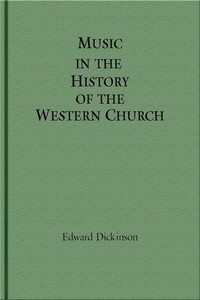
Music in the History of the Western Church With an Introduction on Religious Music Among Primitive and Ancient Peoples — Story, Setting & Ideas can be approached with a clearer sense of reading commitment from its source measurements: 114,144 words, 8 hr 17 min estimated reading time, and 12 detected text sections.
The text analysis averages about 27.5 words per sentence, while the detected sections provide another way to judge how the source is divided.
Project Gutenberg metadata also associates the work with “Church music,” connecting these edition facts with the source record’s subject description.
Explore this collection
These alternatives are selected using recorded categories and estimated reading time.
About 547 minutes
Music History
125,711 recorded words. 50 minutes difference from this book's estimate.
View Gutenberg source #20293About 556 minutes
Music History
127,862 recorded words. 59 minutes difference from this book's estimate.
View Gutenberg source #74367About 391 minutes
Music History
89,879 recorded words. 106 minutes difference from this book's estimate.
View Gutenberg source #66216Search stored excerpts and compare books → Choose by your preferences →
Choices use stored catalog measurements. Estimates vary with reading speed. A shared category is a catalog label, not a claim that two books have the same argument or literary quality.
Search reads excerpt text stored with this catalog and links to its associated Gutenberg record. The connection is stored in the site database; this tool does not recheck that every excerpt is word-for-word identical to that external record. Excerpt search does not cover every chapter and does not verify historical publication dates.
Catalog snapshot checked: 2026-09-26. Coverage: 98 public books, 98 available source excerpts.
Calculated from edition completeness, EPUB availability, text structure and catalogue metadata. Not a user rating.
Total of 100 points, scaled to a 2.5-5.0 range. Editions with an empty description or a missing EPUB file are not scored.
Public-domain source text
The source text is kept in the dedicated reader, separate from this catalogue record and its commentary.
Edward Dickinson opens his 1902 study by framing church music as a perennial problem: how can song serve worship without sacrificing its integrity as fine art? The preface immediately establishes a dual focus—liturgical function versus artistic freedom—that will recur throughout the work. Dickinson, a professor at Oberlin, addresses ministers and non-professional music lovers, aiming to foster historical awareness as a guard against what he calls "capricious perversions of judgment." The table of contents reveals a sweeping arc from primitive religious music to contemporary American church music, with substantial chapters on Gregorian chant, Lutheran hymnody, and J.S. Bach.
The first two chapters establish a foundation that is anthropological as well as musical. Dickinson begins with "Primitive and Ancient Religious Music," then moves to "Ritual and Song in the Early Christian Church." This progression suggests that he sees Christian music as emerging from a broader human impulse toward sacred song. The early chapters likely trace how the Church gradually formalized its musical practices, drawing on Jewish psalmody and adapting the musical resources of the Greco-Roman world. Readers should note that Dickinson treats the Gregorian chant not merely as a repertoire but as a legal, universal, and unchangeable foundation—a phrase he uses later that echoes his introductory framing of music as a "detail of the sacerdotal office."
Chapter VII, "The Rise of the Lutheran Hymnody," presents a sharp contrast between Catholic and Protestant musical systems. Dickinson characterizes Catholic music as clerical, prescribed, and liturgic, while Lutheran music is laic, free, spontaneous, and democratic. He grounds this distinction in theology: the Protestant concept of a universal priesthood restores the offices of worship to the body of believers, making congregational song a natural expression. The author explicitly states that the Catholic Church has "consistently repressed" congregational singing, not on aesthetic grounds but because song, like prayer, is seen as a liturgic office. This binary framework—clerical versus laic, official versus democratic—structures much of the later narrative.
Chapters VIII and IX focus on the rise of the German cantata and passion, culminating in Johann Sebastian Bach. Dickinson positions Bach as the culmination of German Protestant music, but the excerpts do not reveal his specific analysis of Bach's works. Given the book's overall argument, Bach likely represents the synthesis of Lutheran hymnody with learned contrapuntal art. Readers should expect Dickinson to discuss how Bach's music balances the congregational hymn tradition with the demands of artistic complexity. The author's earlier concern with "purity and appropriateness" in church music may inform his evaluation of Bach as a model of consecrated artistry.
The final chapters address the musical systems of the Church of England, congregational song in England and America, and "Problems of Church Music in America." Dickinson expresses confidence that reform is underway, citing the St. Cecilia Society and the Paris Schola Cantorum as forces for improvement. He notes that the Gregorian chant provides a unifying core that prevents corruption from spreading to the heart of the system. The American chapters likely grapple with the challenges of a diverse, democratic society where no single liturgical tradition dominates. Dickinson's closing tone is cautiously optimistic, emphasizing the growing interest in historical masters and sound views of art education.
Dickinson's study rewards readers who attend to his recurring binary oppositions—clerical versus laic, official versus democratic, liturgic versus free. These categories are not merely descriptive but evaluative, reflecting his conviction that historical knowledge promotes humility and guards against capricious judgment. The book's structure, moving from primitive rites to contemporary American problems, invites readers to see each era's musical choices as responses to enduring tensions between worship and art.
I remember how Dickinson’s book, with its quiet weight of centuries, taught me that music is never just sound—it is a people’s prayer. That feeling returns whenever I hold old Twelve Good Musicians: From John Bull to Henry Purcell — Background and Themes, where each composer seems a friend I have known for years. Such kinship sustains a lifetime at the shelves.
Build a private reading journal entry for this title.