About 279 minutes
The Love Affairs of Great Musicians, Volume 2 — Story, Setting & Ideas
Composers
64,022 recorded words. 14 minutes difference from this book's estimate.
View Gutenberg source #11419
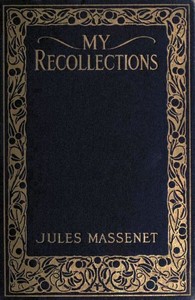
The catalog record for My Recollections — Story, Setting & Ideas provides practical reading context through 60,738 words, 4 hr 25 min estimated reading time, and 7 detected text sections.
The text analysis averages about 19.0 words per sentence, while the detected sections provide another way to judge how the source is divided.
Project Gutenberg metadata also associates the work with “Composers -- France -- Biography,” connecting these edition facts with the source record’s subject description.
Explore this collection
These alternatives are selected using recorded categories and estimated reading time.
About 279 minutes
Composers
64,022 recorded words. 14 minutes difference from this book's estimate.
View Gutenberg source #11419About 283 minutes
Composers
64,903 recorded words. 18 minutes difference from this book's estimate.
View Gutenberg source #3788About 283 minutes
Composers
65,059 recorded words. 18 minutes difference from this book's estimate.
View Gutenberg source #46316Search stored excerpts and compare books → Choose by your preferences →
Choices use stored catalog measurements. Estimates vary with reading speed. A shared category is a catalog label, not a claim that two books have the same argument or literary quality.
Search reads excerpt text stored with this catalog and links to its associated Gutenberg record. The connection is stored in the site database; this tool does not recheck that every excerpt is word-for-word identical to that external record. Excerpt search does not cover every chapter and does not verify historical publication dates.
Catalog snapshot checked: 2026-09-26. Coverage: 98 public books, 98 available source excerpts.
Calculated from edition completeness, EPUB availability, text structure and catalogue metadata. Not a user rating.
Total of 100 points, scaled to a 2.5-5.0 range. Editions with an empty description or a missing EPUB file are not scored.
Public-domain source text
The source text is kept in the dedicated reader, separate from this catalogue record and its commentary.
Massenet opens his recollections with a precise origin: a diary given by his mother on his tenth birthday, a long-shaped notebook from the little Bon Marché. This daily practice, she explained, would make him confess wrongdoings in writing, placing conscience at the center of his upbringing. The first test came when he secretly ate a square of chocolate and, after hesitation, recorded it—earning forgiveness and a lesson in honesty. From that day, he claims, he always obtained permission for later indulgences. This anecdote establishes a pattern: the memoir is built from jotted notes, good or bad, gay or sad, kept constantly in mind. The structure thus mirrors the diary habit, moving episodically through scenes of childhood, conservatoire, and operatic triumphs.
The memoir’s opening establishes its compositional method: Massenet wrote from day-to-day notes, a practice begun at age ten. The diary’s physical description—a long-shaped book from the early Bon Marché—grounds the narrative in a specific object. This habit shapes the book’s episodic structure, as each chapter reads like an entry expanded. The chocolate incident illustrates how the diary enforced self-examination, a moral framework that recurs when Massenet later records anxieties over premieres. The diary habit also explains the memoir’s tone: intimate, confessional, yet selective. He notes that he kept notes of recollections “be they good or bad,” implying a deliberate curation of memory. Readers should expect a sequence of vivid scenes rather than a continuous autobiography, each anchored by a date or event.
Massenet’s account of Le Cid’s premiere reveals a recurring pattern: he cannot stay away from the theater. After Manon’s performance, he goes to the Opéra instead of home, “an irresistible power” pulling him. He overhears a journalist say “It is splitting, my dear chap,” and runs to the directors’ room. The contradictory verdict—Mme. Krause embraces him saying “It’s a triumph!”—shows his reliance on trusted voices. Later, a telegram announcing the fifth performance postponed sends him into a faint at a restaurant in Lyons. These episodes are not isolated; they form a structural motif of suspense and relief. The memoir repeatedly cuts between performance and aftermath, between public reception and private collapse. The reader watches Massenet oscillate between confidence and dread, a rhythm that defines his narrative voice.
Massenet’s life as a traveling composer structures the memoir’s geography. He leaves Paris for Lyons, where Hérodiade and Manon are given, and receives news of Le Cid’s postponement while dining with poets. The telegram arrives mid-meal, and he faints. This scene typifies how the memoir moves between cities: Paris, Lyons, Bayreuth, Chantilly. Each location brings a different social circle—journalists in Paris, provincial poets in Lyons, royalty at Chantilly. The journey to Germany in Chapter XVII, to hear Parsifal at Bayreuth, is a pilgrimage. He visits the city church dedicated to Mary Magdalene, drawn by “what memories” (left unspecified). The memoir’s structure thus mirrors a tour, with each stop offering a new anecdote. Readers should note how place triggers memory: a restaurant, a theater wing, a library at a château.
Massenet includes a letter from the Duc d’Aumale requesting a box for Le Cid on a specific Friday, December 11. He is “touched and proud” by this attention. The scene shifts to the Château de Chantilly, where he stays with fellow Institute members—painters Léon Bonnat, Benjamin Constant, Edouard Detaille, and Gérôme. The prince receives them with simplicity, pipe in mouth, talking in the library “as he had so often done in camp among our soldiers.” Massenet generalizes: “Only the great ones of earth know how to produce such moments of delightful familiarity.” This pattern recurs: a moment of honor is followed by a scene of informal fellowship. The memoir balances public recognition with private ease, using these contrasts to shape its emotional arc. The reader sees Massenet as both celebrated artist and grateful guest.
Massenet records the hundredth performance of Le Cid at the Opéra in October 1900, and a newspaper clipping from November 21, 1911, noting a packed house and enthusiastic applause. He lists the singers who performed Chimène over the years: Fidès Devriès, Rose Caron, Adiny, Mérentié, and Louise Grandjean. This roll call serves as a structural coda, showing the work’s longevity and the changing interpreters. The memoir does not dwell on the opera’s content but on its performance history. The reader sees Massenet tracking his work through time, measuring success by repeated productions and by the artists who brought his scores to life. This forward-looking perspective contrasts with the diary’s daily focus, giving the memoir a dual temporal structure: the immediate moment and the retrospective survey.
Massenet’s memoir rewards readers who attend to its structural cues: the diary habit, the anxious vigils, the movement between cities, and the roll calls of singers and patrons. Each chapter offers a self-contained vignette, yet recurring motifs—telegrams, fainting, royal attentions—bind them into a coherent portrait. The book is best read as a series of scenes rather than a continuous narrative, with the understanding that Massenet selected and shaped these memories from his daily notes. His voice remains intimate, often self-deprecating, and always focused on the concrete details of a composer’s life.
Reading how Massenet’s mother taught him to keep a diary reminded me of my own dog-eared notebook from years ago, half-filled with penciled half-thoughts. That same gentle intimacy surfaced later in The Life of Johannes Brahms (Vol 2 of 2) — A Closer Reading, where his letters felt like listening to a friend pause mid-sentence, trusting the silence between words.
Capture what you thought, learned, and would like to remember.