About 151 minutes
Twelve Good Musicians: From John Bull to Henry Purcell — Background and Themes
Music History
34,636 recorded words. 9 minutes difference from this book's estimate.
View Gutenberg source #39935
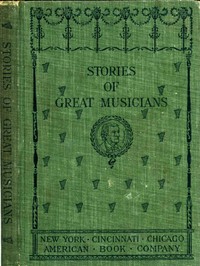
This digital edition of Stories of Great Musicians — Themes and Context is described by source-level measurements including 36,711 words, 2 hr 40 min estimated reading time, and 5 detected text sections.
The text analysis averages about 13.2 words per sentence, while the detected sections provide another way to judge how the source is divided.
Project Gutenberg metadata also associates the work with “Musicians -- Juvenile literature,” connecting these edition facts with the source record’s subject description.
Explore this collection
These alternatives are selected using recorded categories and estimated reading time.
About 151 minutes
Music History
34,636 recorded words. 9 minutes difference from this book's estimate.
View Gutenberg source #39935About 173 minutes
Music History
39,759 recorded words. 13 minutes difference from this book's estimate.
View Gutenberg source #64536About 141 minutes
Music History
32,204 recorded words. 19 minutes difference from this book's estimate.
View Gutenberg source #21542Search stored excerpts and compare books → Choose by your preferences →
Choices use stored catalog measurements. Estimates vary with reading speed. A shared category is a catalog label, not a claim that two books have the same argument or literary quality.
Search reads excerpt text stored with this catalog and links to its associated Gutenberg record. The connection is stored in the site database; this tool does not recheck that every excerpt is word-for-word identical to that external record. Excerpt search does not cover every chapter and does not verify historical publication dates.
Catalog snapshot checked: 2026-09-26. Coverage: 98 public books, 98 available source excerpts.
Calculated from edition completeness, EPUB availability, text structure and catalogue metadata. Not a user rating.
Total of 100 points, scaled to a 2.5-5.0 range. Editions with an empty description or a missing EPUB file are not scored.
Public-domain source text
The source text is kept in the dedicated reader, separate from this catalogue record and its commentary.
The authors of Stories of Great Musicians consistently employ a narrative voice that blends admiration with instructional clarity. In the preface, they state their aim to set "a high standard" for children through biography, and this purpose shapes every chapter. The prose is direct, often using short declarative sentences to describe pivotal moments: "Felix came springing into the room. He was a handsome, bright-looking boy, with clear and sparkling eyes." Such descriptions prioritize visual immediacy over psychological depth, making each composer accessible. Dialogue is used sparingly but effectively, as when Goethe tells young Mendelssohn, "You are my David," a biblical allusion that elevates the boy's role. The authors also insert explanatory asides, like noting that Mendelssohn "admired the works of Sir Walter Scott," to connect composers to broader cultural touchstones. These choices reveal a deliberate strategy to inspire without overwhelming, using concrete details to anchor each life story.
The vocabulary in Stories of Great Musicians is carefully calibrated for a juvenile audience. Abstract concepts are rendered concrete: success is described as something that "comes only to him who earns success," a maxim repeated in the preface. Musical terms are introduced with context, such as "overture" explained as music that makes you "imagine that you were in fairyland." The authors avoid technical jargon, instead using sensory language: "the songs of the elves and woodland sprites" evokes Mendelssohn's Midsummer Night's Dream overture. When describing Bach's or Handel's work, they focus on effort rather than theory, using verbs like "striving" and "persistent endeavor." This diction reflects the educational mission: to instill moral lessons through accessible storytelling. The occasional use of exclamation points—"Surely, a child could not have done such work!"—adds dramatic emphasis, mimicking an adult's wonder to engage young readers. Overall, the word choice prioritizes clarity and inspiration over musical precision.
Dialogue in these sketches serves to reveal character and advance the narrative without lengthy exposition. When Goethe says to Mendelssohn, "Let us hear what this young head has thought of," the line conveys both the poet's warmth and the boy's precocity. Similarly, the musicians' exclamation, "Did young Mendelssohn compose the music that we just played?" underscores the astonishment of adults, reinforcing the child's genius. The authors use dialogue to create scenes of recognition: Goethe's remark, "You are my David," is a biblical reference that frames Mendelssohn as a gifted youth. In the Mozart excerpt (not fully shown), similar patterns likely appear—adults expressing surprise at the child's abilities. These exchanges are brief but pointed, avoiding long conversations. They function as plot devices that highlight the composer's exceptional nature while keeping the prose lively. The dialogue is always in service of the biographical lesson, never straying into idle chatter.
The authors rely on vivid visual descriptions to imprint each composer's image on the reader's mind. Mendelssohn is introduced with "waving black hair fell over his shoulders" and "clear and sparkling eyes," details that create a romanticized portrait. Physical settings are sketched with similar economy: "sheets of music were scattered all about" in the music room, suggesting creative disorder. These descriptions are formulaic but effective, often pairing a character's appearance with their emotional state: "Felix sprang up. He looked eagerly about him." The illustrations listed in the front matter—such as "THE CHILD HANDEL" and "MOZART AT THE ORGAN"—indicate that the text was designed to complement images, but the prose itself is pictorial. The authors also use light and movement: "sparkling eyes" and "springing into the room" convey energy. This pattern of visual cues makes each scene memorable, especially for young readers who benefit from concrete imagery.
Each chapter follows a predictable arc: childhood promise, a key encounter, and a summary of achievements. The Mendelssohn chapter, for instance, opens with his visit to Goethe, then transitions to his travels and works. The authors use transitional phrases like "You must not think that Felix spent all his time in visits" to correct potential misconceptions and maintain a moralizing tone. The preface explicitly states that biography is "a potent factor" in education, and the structure reflects this: each life is a lesson in "untiring effort." The chapters are short, averaging around 7,000 words, with clear section breaks. The authors also include direct addresses to the reader, such as "If you could hear the beautiful music," which invite participation. This formulaic approach ensures consistency across the ten composers, from Bach to Wagner. While it may feel repetitive to an adult, it provides a reliable framework for young readers to absorb historical and musical information.
The editorial choices in Stories of Great Musicians reveal a deliberate pedagogical design. By focusing on visual description, simplified diction, and moral exemplars, Scobey and Horne create an accessible entry point to music history. Readers should note that the excerpts provide only partial views of each composer's life; the full text likely extends these patterns. For those interested in how early twentieth-century educators shaped cultural literacy, this volume offers a clear case study in biographical writing for children.
Reading how these sketches shape Bach and Mozart for young eyes, I remembered my own first encounter with Mendelssohn—sitting on a worn carpet, sunlight on the page. That same hushed discovery returned while leafing through the broader reflections in The art of music, Vol. 05 (of 14) — Reading Notes, where the notes felt less like instruction and more like a patient friend remembering the music aloud.
Capture what you thought, learned, and would like to remember.