About 180 minutes
Religious Folk-Songs of the Southern Negroes — Text and Context
Music History
41,316 recorded words. 7 minutes difference from this book's estimate.
View Gutenberg source #39078
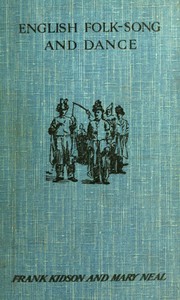
English Folk-Song and Dance — Inside the Classic can be approached with a clearer sense of reading commitment from its source measurements: 39,759 words, 2 hr 53 min estimated reading time, and 12 detected text sections.
The text analysis averages about 22.2 words per sentence, while the detected sections provide another way to judge how the source is divided.
Project Gutenberg metadata also associates the work with “Folk songs, English -- England -- History and criticism,” connecting these edition facts with the source record’s subject description.
Explore this collection
These alternatives are selected using recorded categories and estimated reading time.
About 180 minutes
Music History
41,316 recorded words. 7 minutes difference from this book's estimate.
View Gutenberg source #39078About 160 minutes
Music History
36,711 recorded words. 13 minutes difference from this book's estimate.
View Gutenberg source #37353About 193 minutes
Music History
44,387 recorded words. 20 minutes difference from this book's estimate.
View Gutenberg source #67545Search stored excerpts and compare books → Choose by your preferences →
Choices use stored catalog measurements. Estimates vary with reading speed. A shared category is a catalog label, not a claim that two books have the same argument or literary quality.
Search reads excerpt text stored with this catalog and links to its associated Gutenberg record. The connection is stored in the site database; this tool does not recheck that every excerpt is word-for-word identical to that external record. Excerpt search does not cover every chapter and does not verify historical publication dates.
Catalog snapshot checked: 2026-09-26. Coverage: 98 public books, 98 available source excerpts.
Calculated from edition completeness, EPUB availability, text structure and catalogue metadata. Not a user rating.
Total of 100 points, scaled to a 2.5-5.0 range. Editions with an empty description or a missing EPUB file are not scored.
Public-domain source text
The source text is kept in the dedicated reader, separate from this catalogue record and its commentary.
Frank Kidson and Mary Neal open their joint study with a quotation from Joseph Addison, who praised the songs and fables passed down among common people. This choice signals the authors' interest in vernacular tradition rather than high art. The book is divided into two distinct parts: the first, by Kidson, treats folk-song; the second, by Neal, addresses folk-dance. Each section draws on historical sources, contemporary fieldwork, and comparative anthropology. Kidson acknowledges Lucy Broadwood for a tune and suggestions, while Neal references the Golden Bough to link Morris steps to ancient ritual. The result is a work that blends antiquarian collection with early twentieth-century theories of cultural evolution.
Kidson devotes separate chapters to narrative ballads, love songs, pastorals, drinking songs, highwayman and poacher songs, soldier songs, sea songs, pressgang songs, hunting and sporting songs, songs of labour, traditional carols, and children's singing-games. This taxonomy reveals a systematic effort to map the social contexts of folk-song. The categories are not merely thematic; they reflect the occupations and experiences of the singers. For instance, pressgang songs and sea songs are distinguished from soldier songs, indicating a sensitivity to the specific hardships of naval impressment versus army service. Kidson also includes a chapter on the ballad sheet and song garland, showing attention to the printed transmission of oral material.
Mary Neal's section on folk-dance is more speculative than Kidson's. She proposes that the Morris dance descends from sun-worship, citing the Golden Bough and comparing English dances to those of the Roman Salii. She lists three reasons: the processional form at Bampton-in-the-Bush, the circular and semicircular evolutions in dances from Abingdon and Headington, and the appearance of a King and Queen figure. Neal writes that the Abingdon dances 'end with a complete circle' and that Bean-setting begins with 'two half-circles danced in opposite directions.' She interprets these patterns as mimetic magic intended to influence the sun's course. The argument is presented as plausible rather than proven, and Neal notes that the etymological link between 'Morris' and 'Mamurius' is not taken seriously by the author she cites.
The book includes photographs of Morris dancers at Bampton-in-the-Bush and Abingdon, credited to the Daily Chronicle and the Espérance Morris Book. These images ground the text in observable practice. Neal describes the Bampton dancers as having 'an unbroken tradition going back some hundreds of years' and notes their 'slow, dignified rhythmic movement' in processional form. The set dances, by contrast, involve 'wild leaps, twirlings round, hand-clapping, stick clashing, and the waving of handkerchiefs.' This contrast between processional and set dances is one of the few places where the authors offer a direct observation of living tradition, rather than historical reconstruction.
Kidson and Neal rely heavily on printed sources and comparative anthropology. Kidson's chapters on song types do not include transcriptions of tunes or full lyrics; he refers to the existence of such material but does not reproduce it. Neal's ritual hypothesis depends on the Golden Bough rather than on local testimony. The book does not claim to have collected new songs or dances firsthand. Kidson's note thanks Lucy Broadwood for 'a folk-tune of her collecting,' but no tune appears in the excerpts. The authors are synthesizers rather than field collectors, and their work is best understood as a summary of early twentieth-century knowledge about English folk tradition, filtered through the lens of contemporary scholarship.
Readers interested in the raw material of folk-song and dance should supplement this volume with the collections of Cecil Sharp or the journals of the Folk-Song Society. Kidson and Neal provide a useful overview of categories and historical theories, but their evidence is often secondhand. The book's value lies in its snapshot of how two early revivalists understood their subject—as a living link to prehistoric ritual and as a body of work worthy of systematic classification.
In English Folk-Song and Dance, Kidson finds rituals hiding in plain steps, old suns behind the Morris bells. It reminds me of another quiet volume, The liberty minstrel — Context and Discussion, where freedom hums beneath the verses. Both books hold that ache of something older, singing through cracks in time. I often shelve them side by side, as if they might exchange whispered tunes.
Build a private reading journal entry for this title.