1

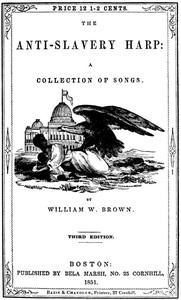
The Anti-slavery Harp: A Collection of Songs for Anti-slavery Meetings — Key Ideas to Explore
(0 User reviews)
770
Project Gutenberg
2018
Not confirmed
Slavery -- United States -- Poetry; Antislavery movements -- Songs and music; Songs, English -- United States -- Texts
Readers of public-domain and historical texts
Project Gutenberg digital edition
en
Edition facts
Words
15,000
Reading time
66 min
Text sections
48
This digital edition of The Anti-slavery Harp: A Collection of Songs for Anti-slavery Meetings — Key Ideas to Explore is described by source-level measurements including 15,000 words, 1 hr 6 min estimated reading time, and 48 detected text sections.
The text analysis averages about 20.4 words per sentence, while the detected sections provide another way to judge how the source is divided.
Project Gutenberg metadata also associates the work with “Slavery -- United States -- Poetry,” connecting these edition facts with the source record’s subject description.
Source:
Project Gutenberg record #58414
William Wells Brown's 1851 songbook for anti-slavery meetings pairs familiar hymn and folk tunes with lyrics that shift from lament to militant resolve, using specific musical directions and recurring imagery of flags, mothers, and biblical justice.
Editorial Edition Score
4.7/5
★★★★★
★★★★★
Calculated from edition completeness, EPUB availability, text structure and catalogue metadata. Not a user rating.
How this score is calculated
- Description quality20 pts
- Title & short description10 pts
- Source metadata20 pts
- Text length15 pts
- Chapters / structure15 pts
- EPUB file integrity20 pts
Total of 100 points, scaled to a 2.5-5.0 range. Editions with an empty description or a missing EPUB file are not scored.
Edition quality
Read the Text
long ago--long, long ago!
Let me look back on the days of my youth-- Long, long ago--long ago! Master withheld from me knowledge and truth-- Long, long ago--long ago! Crushed all the hopes of my earliest day, Sent me from father and mother away-- Forbade me to read, nor allowed me to pray-- Long, long ago--long, long ago!
I hear the cry of millions, of millions, of millions, I hear the cry of millions, of millions in bonds; Oh! set the captive free, set him free, set him free, Oh! set the captive free from his chains.
I hear the voice of Garrison, of Garrison, of Garrison, I hear the voice of Garrison, loud pleading for the slave; Oh! set the captive free, set him free, set him free, Oh! set the captive free from his chains.
I hear the voice of Phillips, of Phillips, of Phillips, I hear the voice of Phillips, in strain of eloquence; Oh! set the captive free, set him free, set him free, Oh! set the captive free from his chains.
I hear the voice of Foster, of Foster, of Foster, I hear the voice of Foster, against the priesthood; Oh! set the captive free, set him free, set him free, Oh! set the captive free from his chains.
I hear the voice of Pillsbury, of Pillsbury, of Pillsbury, I hear the voice of Pillsbury, with all his sarcasm; Oh! set the captive free, set him free, set him free, Oh! set the captive free from his chains.
I hear the voice of Remond, of Remond, of Remond, I hear the voice of Remond, on prejudice ’gainst color; Oh! set the captive free, set him free, set him free, Oh! set the captive free from his chains.
I hear the voice of Buffum, of Buffum, of Buffum, I hear the voice of Buffum, with a few more facts; Oh! set the captive free, set him free, set him free, Oh! set the captive free from his chains.
I hear the voice of Quincy, of Quincy, of Quincy, I hear the voice of Quincy, in words of living truth, Oh! set the captive free, set him free, set him free, Oh! set the captive free from his chains.
I hear the voice of Walker, of Walker, of Walker, I hear the voice of Walker, and see his “Branded Hand;” Oh! set the captive free, set him free, set him free, Oh! set the captive free from his chains.
I hear the voice of Giddings, of Giddings, of Giddings, I hear the voice of Giddings, in Congress, for the slave; Oh! set the captive free, set him free, set him free, Oh! set the captive free from his chains.
I hear the voice of thousands, of thousands, of thousands, I hear the voice of thousands, in favor of “Disunion;” Oh! set the captive free, set him free, set him free, Oh! set the captive free from his chains.
FLIGHT OF THE BONDMAN.
DEDICATED TO WILLIAM W. BROWN,
_And Sung by the Hutchinsons_.
From the crack of the rifle and baying of hound, Takes the poor panting bondman his flight; His couch through the day is the cold damp ground, But northward he runs through the night. Chorus. O, God speed the flight of the desolate slave, Let his heart never yield to despair; There is room ’mong our hills for the true and the brave, Let his lungs breathe our free northern air!
O, sweet to the storm-driven sailor the light, Streaming far o’er the dark swelling wave; But sweeter by far ’mong the lights of the night, Is the star of the north to the slave. O, God speed, &c.
Cold and bleak are our mountains and chilling our winds, But warm as the soft southern gales Be the hands and the hearts which the hunted one finds, ’Mong our hills and our own winter vales. O, God speed, &c.
Then list to the ’plaint of the heart-broken thrall, Ye blood-hounds, go back to your lair; May a free northern soil soon give freedom to all, Who shall breathe in its pure mountain air. O, God speed, &c.
THE SWEETS OF LIBERTY.
AIR--Is there a heart, &c.
Is there a man that never sighed To set the prisoner free? Is there a man that never prized The sweets of liberty? Then let him, let him breathe unseen, Or in a dungeon live; Nor never, never know the sweets That liberty can give.
Is there a heart so cold in man, Can galling fetters crave? Is there a wretch so truly low, Can stoop to be a slave? O, let him, then, in chains be bound, In chains and bondage live; Nor never, never know the sweets That liberty can give.
William Wells Brown's The Anti-slavery Harp (third edition, 1851) is a songbook designed for collective singing at anti-slavery meetings. Each lyric is headed by a tune name—'Air—Freedom's Banner,' 'Air—Araby's Daughter'—indicating that the words were meant to be sung to melodies already known to audiences. The compiler, a formerly enslaved author and activist, selected songs that move between lament, exhortation, and martial resolve. The opening piece, 'Freedom's Banner,' addresses the nation directly, contrasting the flag's ideal of liberty with the reality that it 'floats above three millions slaves.' This tension between patriotic symbol and abolitionist critique recurs throughout the collection.
Tunes as Political Vessels
The musical directions are not incidental. By specifying familiar airs—'Scots wha hae,' 'Kinloch of Kinloch'—Brown ensured that abolitionist arguments could be sung to tunes already associated with rebellion or sentiment. 'We're Coming, We're Coming,' set to 'Kinloch of Kinloch,' borrows the Scottish melody's martial character for lines like 'Our motto is FREEDOM, our country the world.' The pairing of new words with known music made the songs immediately usable at gatherings, turning a printed collection into a participatory tool. The third edition's Boston imprint (Bela Marsh) and the press of Bazin & Chandler suggest a network of radical publishing that supported such practical abolitionist materials.
The Recurring Figure of the Slave Mother
Several songs center on enslaved mothers, using their grief to indict the system. 'O, Pity the Slave Mother' imagines a woman 'careworn and weary' who 'sighs as she presses her babe to her breast,' knowing her children may be sold. The lyric insists that 'the grief of that mother can never be known,' a claim that both evokes sympathy and acknowledges the limits of representation. 'Lament of the Fugitive Slave' is more specific: its epigraph quotes Brown's own Narrative, and the speaker addresses a lost mother whose 'Roman-mother spirit' urged him to seek freedom. These songs do not simply sentimentalize motherhood; they use the mother-child bond to measure slavery's cruelty and to ground the demand for emancipation in intimate loss.
From Lament to Collective Action
The collection's emotional arc moves from sorrow to militant hope. Early songs dwell on suffering—'The mildew of slavery has blighted each blossom'—but later pieces shift to collective defiance. 'We're Coming, We're Coming' announces 'the fearless and free' who will 'put down' the 'man-stealing army.' 'On to Victory,' set to 'Scots wha hae,' declares 'We no earthly weapons wield, Light and love our sword and shield,' blending nonresistance with battle imagery. This progression suggests a deliberate ordering: the singer is led from pity to anger to action. The final excerpt, with its promise that 'the banner of Jesus will soon be unfurled,' ties abolition to Christian eschatology, offering a transcendent resolution to the temporal struggle.
Brown's Editorial Hand and the Third Edition
As compiler, Brown selected and arranged the songs, but the extent of his original authorship is unclear from the excerpts. The epigraph to 'Lament of the Fugitive Slave' quotes his own Narrative, placing his personal story within the songbook. The third edition's title page notes it is 'Compiled by William W. Brown,' a phrase that signals curation rather than sole authorship. The collection thus functions as a communal artifact, drawing on multiple voices—some named, some anonymous—to create a repertoire for movement use. Readers encountering the text today should note that the songs were meant to be heard and sung, not silently read; the musical directions are an invitation to performance, not mere decoration.
Because the excerpts represent only a portion of the forty-eight text sections, the full range of tunes and topics remains unknown. Readers may wish to compare the songs' assigned airs with the original melodies to understand how Brown adapted existing musical traditions. The collection rewards attention to its structure: the sequence from lament to mobilization, the repeated motifs of flags and mothers, and the strategic use of familiar tunes all reveal a carefully crafted tool for moral suasion and collective singing.
I found myself humming one of those militant tunes from Brown’s songbook the other day, struck by how a familiar melody could carry such a different weight. It made me recall the quiet way I once listened to Tschaikowsky’s orchestral pieces, hearing sorrow turn to resolve without a single word. Both left me with that ache of something deeply felt. Tschaikowsky and his orchestral music — Background and Themes sat beside me then, a gentler echo of the same mood.
There are no reviews for this eBook.
There are no comments for this eBook.
Reader reflection
How will you remember this book?
Save your reaction, strongest insight, and memorable passage.
Your progress
0
/
10
2
How did the book work for you overall?
3
Would you encourage someone else to read it?
4
How demanding did the text feel?
5
Which part made the strongest impression?
6
Would you read this book again?
7
How strong was your personal connection to the text?
8
How clearly were the main ideas presented?
9
What did this book teach you most?
10