About 92 minutes
The Beggar's Opera — Reading Companion
Opera Performance
20,963 recorded words. 13 minutes difference from this book's estimate.
View Gutenberg source #2421
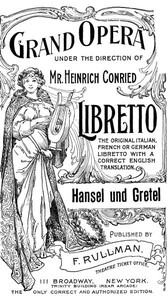
Before opening Hänsel and Gretel: A Fairy Opera in Three Acts — Reading Companion, the edition data offers a quick orientation: 18,003 words, 1 hr 19 min estimated reading time, and 4 detected text sections.
The text analysis averages about 11.0 words per sentence, while the detected sections provide another way to judge how the source is divided.
Project Gutenberg metadata also associates the work with “Operas -- Librettos,” connecting these edition facts with the source record’s subject description.
Explore this collection
These alternatives are selected using recorded categories and estimated reading time.
About 92 minutes
Opera Performance
20,963 recorded words. 13 minutes difference from this book's estimate.
View Gutenberg source #2421About 95 minutes
Opera Performance
21,771 recorded words. 16 minutes difference from this book's estimate.
View Gutenberg source #31880About 56 minutes
Opera Performance
12,760 recorded words. 23 minutes difference from this book's estimate.
View Gutenberg source #49174Search stored excerpts and compare books → Choose by your preferences →
Choices use stored catalog measurements. Estimates vary with reading speed. A shared category is a catalog label, not a claim that two books have the same argument or literary quality.
Search reads excerpt text stored with this catalog and links to its associated Gutenberg record. The connection is stored in the site database; this tool does not recheck that every excerpt is word-for-word identical to that external record. Excerpt search does not cover every chapter and does not verify historical publication dates.
Catalog snapshot checked: 2026-09-26. Coverage: 98 public books, 98 available source excerpts.
Calculated from edition completeness, EPUB availability, text structure and catalogue metadata. Not a user rating.
Total of 100 points, scaled to a 2.5-5.0 range. Editions with an empty description or a missing EPUB file are not scored.
Public-domain source text
The source text is kept in the dedicated reader, separate from this catalogue record and its commentary.
The libretto for Engelbert Humperdinck's Hänsel and Gretel, written by Adelheid Wette, presents the fairy opera in three acts with facing German and English text. The opening scene immediately establishes the children's hunger and their mother's frustration, with Hänsel making brooms and Gretel knitting stockings. The argument over a jug of milk—"There's a jug of milk that will make nice blanc-mange"—leads to a dance that ends with the children falling exhausted on the floor, a moment that captures the opera's blend of domestic realism and theatrical playfulness.
The first act contrasts labor and leisure through specific actions and dialogue. Gretel knits while Hänsel makes brooms, but both complain of hunger. When Hänsel tastes the milk, Gretel "raps his fingers." The children then abandon work for a dance, with Gretel teaching Hänsel steps. The mother's entrance disrupts this play, and in her anger she knocks over the milk pitcher—a turning point that sends the children to the forest. The libretto's stage directions emphasize physical comedy: the children "whirl around the room and fall exhausted on the floor." This sequence establishes a pattern of tension and release that recurs throughout the opera.
In the second act, the setting moves to a forest with the Ilsenstein in the background. Gretel makes a garland of wild roses while Hänsel searches for strawberries. The children's play continues as Hänsel crowns Gretel "queen of the wood." The mood shifts at sunset, and the libretto introduces a dream sequence: Gretel describes hearing "a murmuring and rushing, as though the angels in Heav'n were singing." Hänsel interrupts to count "fourteen angels." The stage directions then reveal the Witch's house as mist clears, transforming the forest into a fairy-tale landscape. This transition from playful innocence to supernatural threat is handled through visual and musical cues in the libretto.
The libretto prints German and English on facing pages, allowing comparison of Wette's original lines with the translation. For example, Gretel's dream speech in German includes "lichte Wölkchen im rosigen Schein" (light clouds in rosy glow), while the English renders it as "rosy clouds above me were floating." The translation often expands or condenses: the German "vierzehn müssen's gewesen sein" becomes "Fourteen angels there must have been!" The Dawn Fairy's song, "I'm up with early dawning," uses a different meter than the German "Ich bin der Morgentau." These differences highlight choices in preserving rhyme, rhythm, and meaning across languages.
The libretto's stage directions do more than describe sets; they advance the plot and signal emotional shifts. In Act I, the mother "seizes a basket" and orders the children to pick strawberries. In Act II, the mist clearing reveals the Witch's house "shining in the rays of the rising sun." The directions also indicate character movements: Gretel "holds Hänsel back" when he approaches the house. The final act includes the Dawn Fairy shaking dewdrops from a bluebell over the sleeping children. These instructions, though brief, create a visual framework for the opera's fairy-tale logic, where domestic objects and natural elements carry symbolic weight.
Readers approaching this libretto for the first time may find it useful to read the German and English passages aloud to appreciate the rhythmic differences. The stage directions offer a concise guide to the opera's visual storytelling, while the dialogue reveals how Wette adapted the familiar fairy tale into a three-act structure. Pay attention to repeated motifs—hunger, dancing, dreaming—that link the scenes together.
I’ve spent many afternoons with Humperdinck’s libretto, its German and English lines breathing side by side. There’s a quiet kinship there—how folk tale becomes opera—that reminds me of my worn copy of Wagner and His Music-Dramas — Themes and Context. Both volumes seem to whisper that music carries what words alone cannot hold. A soft companionship, sitting on the shelf together.
Save your reaction, strongest insight, and memorable passage.