About 54 minutes
Amadis of Gaul, an opera As it is perform'd at the King's Theatre in the Hay-market — Background and Themes
Opera Performance
12,281 recorded words. 2 minutes difference from this book's estimate.
View Gutenberg source #17440
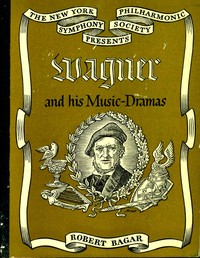
The catalog record for Wagner and His Music-Dramas — Themes and Context provides practical reading context through 12,760 words, 56 min estimated reading time, and 2 detected text sections.
The text analysis averages about 21.9 words per sentence, while the detected sections provide another way to judge how the source is divided.
Project Gutenberg metadata also associates the work with “Wagner, Richard, 1813-1883,” connecting these edition facts with the source record’s subject description.
Explore this collection
These alternatives are selected using recorded categories and estimated reading time.
About 54 minutes
Opera Performance
12,281 recorded words. 2 minutes difference from this book's estimate.
View Gutenberg source #17440About 79 minutes
Opera Performance
18,003 recorded words. 23 minutes difference from this book's estimate.
View Gutenberg source #43289About 92 minutes
Opera Performance
20,963 recorded words. 36 minutes difference from this book's estimate.
View Gutenberg source #2421Search stored excerpts and compare books → Choose by your preferences →
Choices use stored catalog measurements. Estimates vary with reading speed. A shared category is a catalog label, not a claim that two books have the same argument or literary quality.
Search reads excerpt text stored with this catalog and links to its associated Gutenberg record. The connection is stored in the site database; this tool does not recheck that every excerpt is word-for-word identical to that external record. Excerpt search does not cover every chapter and does not verify historical publication dates.
Catalog snapshot checked: 2026-09-26. Coverage: 98 public books, 98 available source excerpts.
Calculated from edition completeness, EPUB availability, text structure and catalogue metadata. Not a user rating.
Total of 100 points, scaled to a 2.5-5.0 range. Editions with an empty description or a missing EPUB file are not scored.
Public-domain source text
The source text is kept in the dedicated reader, separate from this catalogue record and its commentary.
Robert Bagar, writing for the Philharmonic-Symphony Society of New York in 1943, addresses listeners who encounter Wagner primarily through orchestral excerpts rather than full staged operas. His preface makes no claim to originality, drawing instead from existing treatises, but the resulting volume offers a focused look at how Wagner's music-dramas function in concert form. Bagar's prose is brisk and opinionated, distinguishing sharply between Wagner the artist and Wagner the man—a distinction he insists upon early, noting that the composer's life rarely matched the 'super-noble purpose' of his librettos.
Bagar opens with a series of emphatic negatives: 'No artist has known a fiercer urge to create than Richard Wagner. None has labored more mightily to indoctrinate mankind with his convictions. None has been more scathing in his contempt of reaction, of pretense, of outdated mannerisms.' This triple anaphora establishes a tone of absolute commitment, yet Bagar immediately undercuts it by observing that Wagner's personal conduct rarely approached the lofty ideals of his works. The phrasing is deliberate: Wagner 'glamorized human suffering' through the symbol of renunciation, a theme Bagar traces across Der Ring des Nibelungen, Tristan und Isolde, Die Meistersinger, The Flying Dutchman, and Parsifal. The author's word choices—'fiercer,' 'scathing,' 'voluptuous,' 'emotionally overwhelming'—signal a writer unafraid of strong judgments, yet he grounds these in specific observations about Wagner's recurring dramatic motifs.
Bagar consistently addresses an audience that knows Wagner from the concert hall, not the opera house. He describes the Tristan und Isolde Prelude as 'free as to form and ever widening in scope of development,' then itemizes its chief themes: a 'Love Potion' theme and 'Tristan’s Love Glance,' the latter called 'sensuous, even voluptuous in character.' The Liebestod is explained as a 'passionate flow of phrases' drawn from the second-act love duet, with a parenthetical note that Franz Liszt coined the term 'Liebestod' for music Wagner originally called 'Verklärung.' This attention to nomenclature—what to call a passage and why—reflects Bagar's pedagogical aim. He does not assume the reader knows the operas; instead, he describes musical effects in plain language, as when he notes that the Prelude to Die Meistersinger opens with a 'bitter cry' from Hans Sachs's cobbler-song, a motive that 'dies away in resignation' before the horns intone a hymn.
Bagar's most striking structural choice is to quote Wagner's own analysis of the Die Meistersinger Prelude at length, embedding the composer's voice directly into his own text. Wagner's description—'the bitter cry of the man who has determined to renounce his personal happiness, yet who shows the world a cheerful, resolute exterior'—is presented without editorial interruption, allowing the composer to gloss his own work. Bagar then returns to his own voice to summarize the plot: a song contest, the prize of Eva's hand, the young knight Walther von Stolzing. This alternation between primary source and summary creates a layered reading experience. Elsewhere, Bagar includes a biographical aside about Wagner's alleged paternity (Ludwig Geyer) and his mother's theatrical curse, but these details are kept brief, subordinated to the musical discussion. The overall structure moves from general claims about Wagner's artistic aims to specific analyses of individual preludes, then to plot synopsis, mirroring the concert program's logic.
Two motifs recur across Bagar's text: the theme of renunciation and the distinction between Wagner's life and art. Renunciation appears in the opening paragraphs as the central symbol of Wagner's work, then resurfaces in the Meistersinger analysis, where Sachs's 'determined to renounce his personal happiness' is quoted from Wagner himself. Bagar also notes that Wagner wrote Die Meistersinger as a 'lighter work' during a period of doctor-ordered rest, yet the opera took years to complete amid 'financial snarls, domestic tribulations, romantic attachments.' The man-artist split is introduced early—'There is a distinction to be made, therefore, between Wagner the man and Wagner the artist'—and reinforced by the aside that Wagner settled a personal score by caricaturing the critic Eduard Hanslick as the pedantic Beckmesser. These details, drawn from the excerpts, give the reader a sense of the composer's character without requiring knowledge of the full biography.
Bagar's guide is best read as a companion for a concert program, not a substitute for the operas themselves. His willingness to quote Wagner directly, to name themes with their orchestral sources, and to acknowledge the limits of his own originality gives the text a practical, unpretentious character. Readers unfamiliar with the music-dramas will find clear descriptions of musical gestures; those who know them may appreciate the sharpness of Bagar's judgments and the historical context he supplies.
Bagar’s little wartime guide taught me how Wagner built whole worlds from a few aching notes. It made me return to the tales themselves, those old plots of love and ruin. There is a quiet kinship between them, like two shelves holding the same storm. Stories from the operas — Inside the Classic keeps the human heart of it all warm.
Your answers remain private and are stored only in this browser.