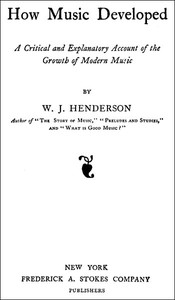
How Music Developed A Critical and Explanatory Account of the Growth of Modern Music — Key Ideas to Explore
Edition facts
The catalog record for How Music Developed A Critical and Explanatory Account of the Growth of Modern Music — Key Ideas to Explore provides practical reading context through 82,316 words, 5 hr 58 min estimated reading time, and 11 detected text sections.
The text analysis averages about 18.1 words per sentence, while the detected sections provide another way to judge how the source is divided.
Project Gutenberg metadata also associates the work with “Music -- History and criticism,” connecting these edition facts with the source record’s subject description.
Calculated from edition completeness, EPUB availability, text structure and catalogue metadata. Not a user rating.
How this score is calculated
- Description quality20 pts
- Title & short description10 pts
- Source metadata20 pts
- Text length15 pts
- Chapters / structure15 pts
- EPUB file integrity20 pts
Total of 100 points, scaled to a 2.5-5.0 range. Editions with an empty description or a missing EPUB file are not scored.
Read the Text
ruses, duets, and trios. There are no solo arias. The aria form had not yet been developed. Here is part of a duet from Monteverde's "Orfeo."
[Music: Monteverde's "Orfeo".]
APOLLO AND ORPHEUS ASCEND TO HEAVEN, SINGING:-- Duet:
Saliam Saliam Can-tan - - - - - d'al cie - - - - lo - - - Saliam - - - - Can-tan - - - - - d'al cie lo
Dove ha vir-tu ve-ra-ce De-gno pre-mio di se Dove ha vir-tu ve-ra-ce De-gno pre-mio di se
di-let to e pa-ce - - - - - - - -
Dove ha vir-tu ve-ra-ce De-gno pre-mio di se Dove ha vir-tu ve-ra-ce De-gno pre-mio di se
di-let - to - e pa-ce. di-let - to - e pa-ce.
The opera ends with a dance. In his "Tancredi e Clorinda," an intermezzo produced in Venice in 1624, Monteverde introduced special instrumental effects which were to become of so great importance in opera. These effects I have already described in Chapter XI, and it is necessary to add here only the statement that they were used, not simply as descriptive of action, but also to aid in conveying to the minds of the auditors the impetuosity and passion of the combatants in the remarkable scene of the fight. It gives one something of a shock to find Monteverde indicating the galloping of horses and the fierceness of their riders, rudely indeed, but with the same musical methods as Wagner employed, with their modern development, in his "Ride of the Valkyrs." Monteverde was, indeed, the Wagner of his time. He broke so completely away from old conventions that Artusi, a writer of Bologna, accused him of having lost sight of the true office of music, "to please the ear."
One of the remarkable things (remarkable at that time) done by Monteverde was to introduce the chord of the dominant seventh unprepared. I shall not undertake to explain the nature of this novelty in harmony, lest I merely confuse the lay reader, but shall ask him to content himself with the statement that such an introduction produced one of those sharp dissonances so common in the music of to-day, and used to express passion. Monteverde began to use these dissonances in his madrigals, of which the Fifth Book, published in 1599, aroused Artusi's ire. But the tremendous effect of the dissonant progressions in "Arianna" quite demolished all the arguments of the opponents of the novelty. Their employment was one of the practices which led directly away from the tonality of the old ecclesiastical scales and toward the modern major and minor keys. Dr. Parry's comments on the work of Monteverde are so pertinent and so lucid that I cannot do better than to quote a part of them:--
"The methods of choral art did not provide for dramatic force or the utterance of passionate feeling; and under such circumstances it was natural that Monteverde should misapply [in his madrigals] his special gifts, which were all in the direction of dramatic expression. The new departure, when it came, was his opportunity. He was not ostensibly a sharer in the first steps of the movement; but directly he joined it he entirely eclipsed all other composers in the field, and in a few years gave it quite a new complexion. For whereas the first composers had not laid any great stress on expression, Monteverde's instinct and aim were chiefly in that direction; and he often sought to emphasize his situations at all costs. His harmonic progressions are for the most part as incoherent as those of his predecessors, and, as might be expected with his peculiar aptitudes, he did very little for design. But he clearly had a very considerable sense of stage effect, and realized that mere monotonous recitative was not the final solution nor even the nucleus of dramatic music. It is true he introduces a great quantity of recitative, but he varies it with instrumental interludes which now and then have some real point and relevancy about them; and with passages of solo music which have definite figure and expression, and with choruses which are more skilfully contrived, and to a certain degree more effective, than those of his predecessors. By this means he broke up the homogeneous texture of the scenes into passages of well-defined diversity, and interested his auditors with contrast, variety, and conspicuously characteristic passages, which heighten the impression of the situation as all stage music should."
Henderson opens his survey by insisting that the history of music as an art must be kept separate from the history of music as popular expression. This distinction, drawn in the first chapter, governs the entire narrative: the medieval church cultivated a liturgical art while popular songs developed independently, and only later did the two streams converge. The book accordingly traces a series of structural oppositions—sacred versus secular, polyphonic versus monophonic, Italian versus German—that shaped the evolution of modern music from Gregorian chant to the music dramas of Wagner.
Church Counterpoint and the Secular Current
The early chapters emphasize that for centuries the only artistic music was ecclesiastical. Henderson describes the Ambrosian and Gregorian chants as unsystematic collections derived from local sources, and credits Nokter Balbulus with introducing sequences. The birth of counterpoint in the church is presented as a purely liturgical development, yet the author repeatedly notes that popular music continued alongside it, eventually forcing changes. The tension between the two is a recurring pattern: the church’s polyphonic style reached its golden age, but the simplification of music—a move toward clearer, more singable lines—came partly from secular influences. Henderson’s account of the piano’s evolution similarly contrasts the polyphonic style of earlier keyboard music with the monophonic style that enabled the sonata.
Mendelssohn and the Oratorio’s Divided Heritage
In the chapter on oratorio, Henderson uses Mendelssohn as a case study in stylistic negotiation. He notes that Mendelssohn rejected both Handel’s Italian manner and Bach’s austere polyphony, seeking instead a graceful, fluent melody suited to Protestant sentiment. The analysis is precise: Henderson points out that Bach’s recitatives, though dramatically direct, were weakened by the evangelist’s narration and by their overly detailed musical character. Mendelssohn’s solution—the chorale as an embodiment of Protestant faith—is presented as a synthesis, but Henderson also criticizes St. Paul for being episodic and lacking dramatic continuity. The discussion is grounded in specific compositional choices, not general praise.
Opera’s National Styles and Reform Impulses
Henderson devotes several chapters to opera, tracing Italian, French, and German traditions from the birth of the form through Gluck, Meyerbeer, and Wagner. The pattern of tension reappears: Italian opera emphasized melody and vocal display, while French opera incorporated spectacle and dance, and German opera sought dramatic unity. Gluck’s reforms are positioned as a reaction against excess, and Wagner’s music drama as the culmination of a long struggle between musical and dramatic priorities. Henderson’s treatment is critical rather than celebratory; he notes, for instance, that Meyerbeer’s influence was significant but does not inflate his reputation. The closing chapter, “The Lessons of Musical History,” explicitly draws these contrasts together, urging readers to see development as a series of choices between competing aesthetic forces.
Readers will benefit from attending to Henderson’s persistent framing of musical history as a set of oppositions—sacred versus secular, polyphonic versus homophonic, national versus universal. The book is less a chronicle of masterpieces than an argument about how stylistic tensions drive change. Because the excerpts are incomplete, the full arc of Henderson’s argument cannot be verified, but the pattern is consistent enough to guide a critical reading: watch for the moments when two traditions collide and a new form emerges.
I keep thinking about Henderson’s quiet tracing of how church song and street song borrowed from each other, and it reminded me of a gentler companion volume sitting beside it, like old sheet music found in a drawer. The art of music. Vol. 01 (of 14) — Reading Notes lingers the same way—less argument, more margin notes from someone who loved the listening itself. It stayed with me softly.
There are no reviews for this eBook.
How will you remember this book?
Save your reaction, strongest insight, and memorable passage.