About 754 minutes
The art of music. Vol. 01 (of 14) — Reading Notes
Music History
173,288 recorded words. 9 minutes difference from this book's estimate.
View Gutenberg source #65658
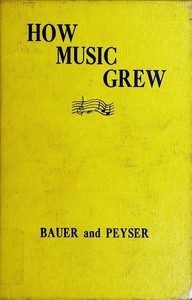
Before opening How music grew, from prehistoric times to the present day — Context and Discussion, the edition data offers a quick orientation: 175,265 words, 12 hr 43 min estimated reading time, and 35 detected text sections.
The text analysis averages about 23.0 words per sentence, while the detected sections provide another way to judge how the source is divided.
Project Gutenberg metadata also associates the work with “Musicians,” connecting these edition facts with the source record’s subject description.
Explore this collection
These alternatives are selected using recorded categories and estimated reading time.
About 754 minutes
Music History
173,288 recorded words. 9 minutes difference from this book's estimate.
View Gutenberg source #65658About 734 minutes
Music History
168,618 recorded words. 29 minutes difference from this book's estimate.
View Gutenberg source #68990About 714 minutes
Music History
164,039 recorded words. 49 minutes difference from this book's estimate.
View Gutenberg source #65865Search stored excerpts and compare books → Choose by your preferences →
Choices use stored catalog measurements. Estimates vary with reading speed. A shared category is a catalog label, not a claim that two books have the same argument or literary quality.
Search reads excerpt text stored with this catalog and links to its associated Gutenberg record. The connection is stored in the site database; this tool does not recheck that every excerpt is word-for-word identical to that external record. Excerpt search does not cover every chapter and does not verify historical publication dates.
Catalog snapshot checked: 2026-09-26. Coverage: 98 public books, 98 available source excerpts.
Calculated from edition completeness, EPUB availability, text structure and catalogue metadata. Not a user rating.
Total of 100 points, scaled to a 2.5-5.0 range. Editions with an empty description or a missing EPUB file are not scored.
Public-domain source text
The source text is kept in the dedicated reader, separate from this catalogue record and its commentary.
From the opening 'Authors’ Greetings,' Marion Bauer and Ethel Peyser establish a distinctly conversational voice, addressing 'Dear Young Readers from Nine to Ninety' and framing their book not as a formal history but as 'a lane parallel to the road along which music has marched.' This informal, almost epistolary tone persists throughout the excerpts, with the authors freely admitting to 'prayerfully and carefully relinquished' topics to avoid an encyclopedia. The narrative voice is that of a friendly guide, using colloquial phrases like 'we have tried to explain as simply as possible, without becoming infantile' and even a pun ('one cannot help playing with “sole”!'). This approach prioritizes accessibility over scholarly detachment, a deliberate choice that shapes the reader's experience.
The authors explicitly state they have 'not tried to write a history' but instead 'follow a lane parallel to the road.' This metaphor signals a selective, thematic approach. They acknowledge 'peculiar omissions,' such as a chapter on singers, because the book 'adheres as closely as possible to the actual creators.' This focus on composers over performers is a structural choice that defines the narrative. The tone is self-deprecating and intimate: they hope readers will 'love music better' after seeing its 'struggle with politics, religion and its critics.' The voice is that of enthusiasts sharing discoveries, not academics delivering facts. This strategy likely makes the dense subject matter more approachable, especially for the intended audience of young readers and novices.
The excerpts reveal sharp shifts in pace. A lengthy, vivid description of a pianoforte's ceremonial arrival in a town—complete with a pastor's blessing, speeches by the mayor and schoolmaster, songs by the Männerchor, and a banquet—unfolds in leisurely, almost novelistic detail. Then, abruptly, the text pivots to a technical explanation of player pianos: 'It is very difficult to know just when this important instrument first was invented.' The prose becomes dense with mechanical specifics—'bellows and pneumatic tubes (which look together like a bunch of gray spaghetti),' 'perforated music rolls,' 'tracker bar.' This contrast between narrative scene-setting and technical exposition shows the authors varying pace to maintain interest, though the technical sections risk overwhelming the reader with jargon.
The authors' direct address to 'Young Readers from Nine to Ninety' establishes an inclusive, intergenerational audience. They use rhetorical questions ('And who can tell which is the most important?') and playful asides ('So in the latter, one cannot help playing with “sole”!'). The tone is encouraging: the player piano is praised for giving 'the music lover who has been denied the study of music a chance to enjoy interpreting great music.' The authors champion accessibility, calling the mechanical player 'not as a substitute for a piano but as an instrument in itself.' This advocacy for democratic music-making aligns with the book's mission to 'attract and stimulate the novice.' The voice is consistently warm, opinionated, and unapologetically subjective, which may charm some readers while striking others as overly familiar.
Readers should approach this book as a guided tour rather than a reference work. The authors' voice is central: they are present on every page, making choices about what to include and how to explain it. Pay attention to the shifts between storytelling and technical description—they reveal what the authors considered 'picturesque' versus necessary. The book's value lies not in comprehensive coverage but in its distinctive, personal perspective on music history, one that invites the reader to share the authors' enthusiasm.
Reading about Bauer and Peyser's chatty omissions reminded me of sitting on my grandfather's porch, him humming a tune he couldn't name. That same warmth surfaced in The art of music, Vol. 04 (of 14) — Text and Context, where the editors' gentle gaps felt like room left for my own listening. Neither book explains everything; both trust the silence between notes.
Answer a few questions and save a private reflection on this device.