About 115 minutes
Early German music in Philadelphia — Inside the Classic
Music History
26,385 recorded words. 2 minutes difference from this book's estimate.
View Gutenberg source #73127
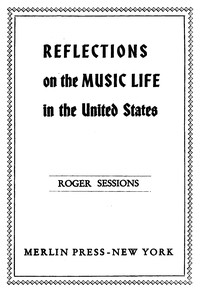
This digital edition of Reflections on the Music Life in the United States — Inside the Classic is described by source-level measurements including 26,809 words, 1 hr 57 min estimated reading time, and 12 detected text sections.
The text analysis averages about 28.8 words per sentence, while the detected sections provide another way to judge how the source is divided.
Project Gutenberg metadata also associates the work with “Music -- United States,” connecting these edition facts with the source record’s subject description.
Explore this collection
These alternatives are selected using recorded categories and estimated reading time.
About 115 minutes
Music History
26,385 recorded words. 2 minutes difference from this book's estimate.
View Gutenberg source #73127About 129 minutes
Music History
29,511 recorded words. 12 minutes difference from this book's estimate.
View Gutenberg source #22089About 129 minutes
Music History
29,666 recorded words. 12 minutes difference from this book's estimate.
View Gutenberg source #54999Search stored excerpts and compare books → Choose by your preferences →
Choices use stored catalog measurements. Estimates vary with reading speed. A shared category is a catalog label, not a claim that two books have the same argument or literary quality.
Search reads excerpt text stored with this catalog and links to its associated Gutenberg record. The connection is stored in the site database; this tool does not recheck that every excerpt is word-for-word identical to that external record. Excerpt search does not cover every chapter and does not verify historical publication dates.
Catalog snapshot checked: 2026-09-26. Coverage: 98 public books, 98 available source excerpts.
Calculated from edition completeness, EPUB availability, text structure and catalogue metadata. Not a user rating.
Total of 100 points, scaled to a 2.5-5.0 range. Editions with an empty description or a missing EPUB file are not scored.
Public-domain source text
The source text is kept in the dedicated reader, separate from this catalogue record and its commentary.
Roger Sessions opens his 1956 study by declaring the musical development of the United States since World War I “tremendous,” yet he immediately warns that quantitative measures—attendance figures, record sales, or money spent—cannot alone reveal a “vital cultural development.” This caution sets the tone for a work that consistently prioritizes qualitative judgment over statistical fashion. Sessions, a composer and Princeton professor, writes from inside the institutions he critiques, offering a perspective shaped by decades of observation.
In the opening pages, Sessions dismisses the common practice of citing “attendance at symphony concerts, sales of ‘classical’ recordings, new orchestras” as merely quantitative. He insists that such data, though “convenient and fashionable,” do not measure cultural vitality. This skepticism toward numerical proof recurs throughout the excerpts: later, when discussing university music programs, he again avoids enrollment figures and instead focuses on the quality of training and the independence of academic institutions from commercial pressures. The reader should note that Sessions rarely offers statistics himself; his evidence is anecdotal and institutional, drawn from his own career and from the structures he has observed.
Sessions devotes considerable attention to the role of universities, which he calls “strongholds of independent and liberal thought” sheltering activities that struggle against “the excesses of commercialism.” He names specific schools—Yale, Michigan, Wisconsin, Illinois, California, Columbia, Harvard, Princeton—and describes their varying approaches: professional Schools of Music versus departments integrated into Liberal Arts, and the novel practice of “Quartets in Residence” such as the Pro Arte Quartet at Wisconsin. Yet he also acknowledges internal tensions: the “divergence between what is proper for the layman and essential for the professional,” and the risk that academic training may inculcate “criteria taken from music history and aesthetic theory rather than from music as a direct experience.” These passages reveal a writer deeply engaged with the practical problems of musical pedagogy, not merely an advocate for university expansion.
Sessions personalizes his argument by recalling his own decision at age thirteen to become a composer, noting that at that time “there was no representative musician” in a certain role—the excerpt cuts off, but the implication is clear: the institutional landscape has shifted dramatically. The table of contents shows chapters on Background and Conditions, Early History, Concerts, Musical Theater, Music Education, Musical Opinion, and Composers and Their Ideas (including Nationalism, Quest for Popularity, and Countercurrents). The excerpts focus on education, but the book’s structure promises a broader survey. Readers should be aware that the available text is incomplete; Sessions’s views on nationalism and popularity, for instance, are not represented here.
Sessions writes as a participant-observer, not a neutral historian. His judgments—on statistics, on commercialism, on academic pitfalls—are those of a composer who has lived through the changes he describes. The book is best read as a personal essay grounded in institutional analysis, not as a comprehensive data-driven survey. Its value lies in the specificity of its observations and the clarity of its critical stance.
Rereading Reflections on the Music Life, I lingered on Sessions’ quiet worry about art bending to commercial noise. It reminded me, strangely, of a different shelf, one where healing meets melody—his fight for honest sound felt like a pulse, and that led me back to Music in Medicine — Reading Companion. Some books share a heartbeat, even when their worlds differ.
Answer a few questions and save a private reflection on this device.