About 117 minutes
Reflections on the Music Life in the United States — Inside the Classic
Music History
26,809 recorded words. 2 minutes difference from this book's estimate.
View Gutenberg source #67239
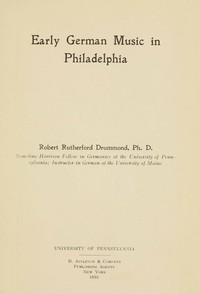
The catalog record for Early German music in Philadelphia — Inside the Classic provides practical reading context through 26,385 words, 1 hr 55 min estimated reading time, and 20 detected text sections.
The text analysis averages about 16.7 words per sentence, while the detected sections provide another way to judge how the source is divided.
Project Gutenberg metadata also associates the work with “Music -- Germany -- History and criticism,” connecting these edition facts with the source record’s subject description.
Explore this collection
These alternatives are selected using recorded categories and estimated reading time.
About 117 minutes
Music History
26,809 recorded words. 2 minutes difference from this book's estimate.
View Gutenberg source #67239About 129 minutes
Music History
29,511 recorded words. 14 minutes difference from this book's estimate.
View Gutenberg source #22089About 129 minutes
Music History
29,666 recorded words. 14 minutes difference from this book's estimate.
View Gutenberg source #54999Search stored excerpts and compare books → Choose by your preferences →
Choices use stored catalog measurements. Estimates vary with reading speed. A shared category is a catalog label, not a claim that two books have the same argument or literary quality.
Search reads excerpt text stored with this catalog and links to its associated Gutenberg record. The connection is stored in the site database; this tool does not recheck that every excerpt is word-for-word identical to that external record. Excerpt search does not cover every chapter and does not verify historical publication dates.
Catalog snapshot checked: 2026-09-26. Coverage: 98 public books, 98 available source excerpts.
Calculated from edition completeness, EPUB availability, text structure and catalogue metadata. Not a user rating.
Total of 100 points, scaled to a 2.5-5.0 range. Editions with an empty description or a missing EPUB file are not scored.
Public-domain source text
The source text is kept in the dedicated reader, separate from this catalogue record and its commentary.
Drummond begins by stating his intention to emphasize secular music, yet immediately acknowledges that religious music dominated the first half of the 18th century in Philadelphia. This tension between stated focus and historical reality sets the tone for a study that must work with what survives. The foreword also reveals that the first two periods receive more detailed treatment because they have been less thoroughly investigated than the later period—a methodological choice that shapes the entire work.
The excerpts show Drummond relying heavily on manuscript evidence, such as Francis Hopkinson's personal music books from 1755 and 1759. These sources allow him to document which composers were known in Philadelphia, with Händel appearing most frequently. The approach is empirical: Drummond lists pieces and composers rather than making broad claims about influence.
Drummond's foreword is unusually candid about his research strategy. He writes that he found it necessary to treat religious music in detail for the first period, even though his primary interest is secular. This admission signals that the book's structure is driven by the available evidence, not by a predetermined narrative. He also notes that the last period has been more thoroughly investigated, so he goes into less detail there. Readers should expect the first two periods to contain more granular information about specific performances and musicians, while the later sections may be more selective.
The foreword also establishes the book's place in the Americana Germanica series, which focused on German-American cultural relations. This context explains why Drummond emphasizes German contributions specifically, rather than offering a general history of Philadelphia music.
The excerpts devote considerable space to Francis Hopkinson's music books. Drummond quotes from Sonneck's work to list the contents of a 1755 manuscript: Italian, French, and English pieces arranged for harpsichord, including works by Händel. A 1759 book contains pieces by Händel, Palma, Vinci, Arne, Pepusch, Boyce, Pergolesi, and Purcell. A third volume, undated, includes Scarlatti, Abel, Stamitz, Vivaldi, and others.
Drummond uses these lists to argue that Hopkinson was familiar with many of the best composers of the world, and that he was especially fond of Händel. He also notes that the presence of German composers like Abel, Stamitz, and Schmidt suggests that German music reached Philadelphia through English channels. The evidence is circumstantial but carefully assembled.
Drummond traces the professional music masters active in Philadelphia: John Beals, then John Palma in 1757, and James Bremner in 1763. He notes that Hopkinson may have studied with any or all of them, but that Bremner is known to have been his teacher. The implication is that these masters, mostly from London, brought with them a repertoire that included German composers.
Drummond speculates that if the music was brought by these masters, then other pupils would have become acquainted with standard composers as well. He singles out Händel, who was almost idolized in England during the 18th century, as having impressed these English-American teachers. The logic is that German music entered Philadelphia indirectly, through the filter of English taste.
Throughout the excerpts, Drummond grapples with the relative scarcity of secular music in early Philadelphia. He acknowledges that religious music was more important in the first half-century, and that his focus on secular music requires him to work with fragmentary evidence. The Hopkinson manuscripts are valuable precisely because they include secular pieces—songs, duets, and instrumental works—alongside sacred ones.
Drummond's method is to let the manuscripts speak for themselves. He does not claim that the pieces listed were performed publicly; only that they were known and studied. This cautious approach reflects the limitations of the historical record. Readers should note that the book's conclusions about musical taste are based on what was owned and copied, not necessarily what was heard in concert.
Drummond's study is best read as a careful reconstruction of musical life from surviving documents. The excerpts show a scholar who is transparent about his sources and his reasoning. Readers interested in the mechanics of cultural transmission—how German music reached America through English intermediaries—will find the detailed manuscript lists and biographical sketches invaluable. The book does not offer a sweeping narrative, but rather a series of well-supported observations about what was played, taught, and valued in 18th-century Philadelphia.
That rainy afternoon, Drummond's careful tracing of Händel through Philadelphia's parlors felt like eavesdropping on quiet lives. The shift from church choirs to secular gatherings lingered, and I found myself wondering how those same melodies crossed oceans of time. Then, almost by chance, I opened How Music Developed A Critical and Explanatory Account of the Growth of Modern Music — Key Ideas to Explore, and the rain outside seemed to slow, as if the whole story had simply been waiting to continue.
Build a private reading journal entry for this title.