The Anti-slavery Harp: A Collection of Songs for Anti-slavery Meetings — Key Ideas to Explore
Edition facts
This digital edition of The Anti-slavery Harp: A Collection of Songs for Anti-slavery Meetings — Key Ideas to Explore is described by source-level measurements including 15,000 words, 1 hr 6 min estimated reading time, and 48 detected text sections.
The text analysis averages about 20.4 words per sentence, while the detected sections provide another way to judge how the source is divided.
Project Gutenberg metadata also associates the work with “Slavery -- United States -- Poetry,” connecting these edition facts with the source record’s subject description.
Calculated from edition completeness, EPUB availability, text structure and catalogue metadata. Not a user rating.
How this score is calculated
- Description quality20 pts
- Title & short description10 pts
- Source metadata20 pts
- Text length15 pts
- Chapters / structure15 pts
- EPUB file integrity20 pts
Total of 100 points, scaled to a 2.5-5.0 range. Editions with an empty description or a missing EPUB file are not scored.
Read the Text
long ago--long, long ago!
Let me look back on the days of my youth-- Long, long ago--long ago! Master withheld from me knowledge and truth-- Long, long ago--long ago! Crushed all the hopes of my earliest day, Sent me from father and mother away-- Forbade me to read, nor allowed me to pray-- Long, long ago--long, long ago!
I hear the cry of millions, of millions, of millions, I hear the cry of millions, of millions in bonds; Oh! set the captive free, set him free, set him free, Oh! set the captive free from his chains.
I hear the voice of Garrison, of Garrison, of Garrison, I hear the voice of Garrison, loud pleading for the slave; Oh! set the captive free, set him free, set him free, Oh! set the captive free from his chains.
I hear the voice of Phillips, of Phillips, of Phillips, I hear the voice of Phillips, in strain of eloquence; Oh! set the captive free, set him free, set him free, Oh! set the captive free from his chains.
I hear the voice of Foster, of Foster, of Foster, I hear the voice of Foster, against the priesthood; Oh! set the captive free, set him free, set him free, Oh! set the captive free from his chains.
I hear the voice of Pillsbury, of Pillsbury, of Pillsbury, I hear the voice of Pillsbury, with all his sarcasm; Oh! set the captive free, set him free, set him free, Oh! set the captive free from his chains.
I hear the voice of Remond, of Remond, of Remond, I hear the voice of Remond, on prejudice ’gainst color; Oh! set the captive free, set him free, set him free, Oh! set the captive free from his chains.
I hear the voice of Buffum, of Buffum, of Buffum, I hear the voice of Buffum, with a few more facts; Oh! set the captive free, set him free, set him free, Oh! set the captive free from his chains.
I hear the voice of Quincy, of Quincy, of Quincy, I hear the voice of Quincy, in words of living truth, Oh! set the captive free, set him free, set him free, Oh! set the captive free from his chains.
I hear the voice of Walker, of Walker, of Walker, I hear the voice of Walker, and see his “Branded Hand;” Oh! set the captive free, set him free, set him free, Oh! set the captive free from his chains.
I hear the voice of Giddings, of Giddings, of Giddings, I hear the voice of Giddings, in Congress, for the slave; Oh! set the captive free, set him free, set him free, Oh! set the captive free from his chains.
I hear the voice of thousands, of thousands, of thousands, I hear the voice of thousands, in favor of “Disunion;” Oh! set the captive free, set him free, set him free, Oh! set the captive free from his chains.
FLIGHT OF THE BONDMAN.
DEDICATED TO WILLIAM W. BROWN,
_And Sung by the Hutchinsons_.
From the crack of the rifle and baying of hound, Takes the poor panting bondman his flight; His couch through the day is the cold damp ground, But northward he runs through the night. Chorus. O, God speed the flight of the desolate slave, Let his heart never yield to despair; There is room ’mong our hills for the true and the brave, Let his lungs breathe our free northern air!
O, sweet to the storm-driven sailor the light, Streaming far o’er the dark swelling wave; But sweeter by far ’mong the lights of the night, Is the star of the north to the slave. O, God speed, &c.
Cold and bleak are our mountains and chilling our winds, But warm as the soft southern gales Be the hands and the hearts which the hunted one finds, ’Mong our hills and our own winter vales. O, God speed, &c.
Then list to the ’plaint of the heart-broken thrall, Ye blood-hounds, go back to your lair; May a free northern soil soon give freedom to all, Who shall breathe in its pure mountain air. O, God speed, &c.
THE SWEETS OF LIBERTY.
AIR--Is there a heart, &c.
Is there a man that never sighed To set the prisoner free? Is there a man that never prized The sweets of liberty? Then let him, let him breathe unseen, Or in a dungeon live; Nor never, never know the sweets That liberty can give.
Is there a heart so cold in man, Can galling fetters crave? Is there a wretch so truly low, Can stoop to be a slave? O, let him, then, in chains be bound, In chains and bondage live; Nor never, never know the sweets That liberty can give.
Is there a breast so chilled in life, Can nurse the coward’s sigh? Is there a creature so debased, Would not for freedom die? O, let him then be doomed to crawl Where only reptiles live; Nor never, never know the sweets That liberty can give.
YE SPIRITS OF THE FREE!
AIR--My faith looks up to thee.
Ye spirits of the free, Can ye forever see Your brother man A yoked and scourged slave, Chains dragging to his grave, And raise no hand to save? Say if you can.
In pride and pomp to roll, Shall tyrants from the soul God’s image tear, And call the wreck their own,-- While, from the eternal throne, They shut the stifled groan And bitter prayer?
Shall he a slave be bound, Whom God hath doubly crowned Creation’s lord? Shall men of Christian name, Without a blush of shame, Profess their tyrant claim From God’s own word?
No! at the battle cry, A host prepared to die, Shall arm for fight-- But not with martial steel, Grasped with a murderous zeal; No arms their foes shall feel, But love and light.
Firm on Jehovah’s laws, Strong in their righteous cause, Their march to save. And vain the tyrant’s mail, Against their battle-hail, Till cease the woe and wail Of tortured slave.
I AM AN ABOLITIONIST.
I am an Abolitionist! I glory in the name: Though now by Slavery’s minions hiss’d And covered o’er with shame, It is a spell of light and power-- The watchword of the free:-- Who spurns it in the trial-hour, A craven soul is he!
I am an Abolitionist! Then urge me not to pause; For joyfully do I enlist In FREEDOM’S sacred cause: A nobler strife the world ne’er saw, Th’ enslaved to disenthral; I am a soldier for the war, Whatever may befall!
I am an Abolitionist! Oppression’s deadly foe; In God’s great strength will I resist, And lay the monster low; In God’s great name do I demand, To all be freedom given, That peace and joy may fill the land, And songs go up to heaven!
I am an Abolitionist! No threats shall awe my soul, No perils cause me to desist, No bribes my acts control; A freeman will I live and die, In sunshine and in shade, And raise my voice for liberty, Of nought on earth afraid.
AIR--Kathleen O’More.
O, deep was the anguish of the slave mother’s heart, When called from her darling forever to part; So grieved that lone mother, that heart-broken mother, In sorrow and woe.
The lash of the master her deep sorrows mock, While the child of her bosom is sold on the block; Yet loud shrieked that mother, poor heart-broken mother, In sorrow and woe.
The babe in return, for its fond mother cries, While the sound of their wailings, together arise; They shriek for each other, the child and the mother, In sorrow and woe.
The harsh auctioneer, to sympathy cold, Tears the babe from its mother and sells it for gold; While the infant and mother, loud shriek for each other, In sorrow and woe.
At last came the parting of mother and child, Her brain reeled with madness, that mother was wild; Then the lash could not smother the shrieks of that mother, Of sorrow and woe.
The child was borne off to a far distant clime, While the mother was left in anguish to pine; But reason departed, and she sank broken-hearted, In sorrow and woe.
That poor mourning mother, of reason bereft, Soon ended her sorrows and sank cold in death; Thus died that slave mother, poor heart-broken mother, In sorrow and woe.
O, list ye kind mothers to the cries of the slave; The parents and children implore you to save; Go! rescue the mothers, the sisters and brothers, From sorrow and woe.
I’LL BE FREE! I’LL BE FREE!
I’ll be free! I’ll be free! and none shall confine With fetters and chains this free spirit of mine; From my youth have I vowed in my God to rely, And despite the oppressor, gain Freedom or die. Though my back is all torn by the merciless rod, Yet firm is my trust in the right arm of God; In his strength I’ll go forth, and forever will be ’Mong the hills of the North, where the bondman is free, ’Mong the hills of the North, where the bondman is free.
Let me go! let me go! to the land of the brave, Where shackles must fall from the limbs of the Slave, Where freedom’s proud eagle screams wild thro’ the sky, And the sweet mountain-birds in glad notes reply. I’ll flee to New England, where the fugitive finds A home ’mid her mountains and deep forest winds, And her hill-tops shall ring out the wrongs done to me, Till responsive they sing, “Let the bondman go free.” Till responsive they sing, “Let the bondman go free.”
New England! New England! thrice blessed and free, The poor hunted slave finds a shelter in thee, Where no blood-thirsty hounds ever dare on his track, At thy stern voice, New England! the monster fell back. Go back! then, ye blood-hounds, that howl in my path, In the land of New England I’m free from your wrath, And the sons of the Pilgrims my deep scars shall see, Till they cry with one voice, “Let the bondman go free.”
That voice shall roll on, ’mong the hills of the North, In murmurs more loud till its thunders break forth; On the wings of the wind shall its deep echoes fly, Swift as lightning above, from sky e’en to sky, Nor charters nor unions its mandates shall check, ’Twill cry, in God’s name, “Go break every yoke,”-- Like the tempests of Heaven, shaking mountain and sea, Shall the North tell the South, “Let the bondman go free.”
Great God! hasten on the glad jubilee, When my brother in bonds shall arise and be free; And our blotted escutcheon be washed from its stains, Now the scorn of the world--Three Millions in chains! O! then shall Columbia’s proud flag be unfurled, The glory of freemen, and pride of the world, While earth’s strolling millions point hither in glee, “To the land of the brave and the home of the free!”
She sings by her wheel at that low cottage door, Which the long evening shadow is stretching before; With a music as sweet as the music which seems Breathed softly and faintly in the ear of our dreams!
How brilliant and mirthful the light of her eye, Like a star glancing out from the blue of the sky! And lightly and freely her dark tresses play O’er a brow and a bosom as lovely as they!
Who comes in his pride to that low cottage door-- The haughty and rich to the humble and poor? ’Tis the great Southern planter--the master who waves His whip of dominion o’er hundreds of slaves.
“Nay, Ellen, for shame! Let those Yankee fools spin, Who would pass for our slaves with a change of their skin; Let them toil as they will at the loom or the wheel, Too stupid for shame and too vulgar to feel!
But thou art too lovely and precious a gem To be bound to their burdens and sullied by them-- For shame, Ellen, shame!--cast thy bondage aside, And away to the South, as my blessing and pride.
O, come where no winter thy footsteps can wrong, But where flowers are blossoming all the year long; Where the shade of the palm-tree is over my home, And the lemon and orange are white in their bloom!
O, come to my home, where my servants shall all Depart at thy bidding and come at thy call; They shall heed thee as mistress with trembling and awe, And each wish of thy heart shall be felt as a law.”
O, could ye have seen her--that pride of our girls-- Arise and cast back the dark wealth of her curls, With scorn in her eye which the gazer could feel, And a glance like the sunshine that flashes on steel:
“Go back, haughty Southron! thy treasures of gold Are dim with the blood of the hearts thou hast sold! Thy home may be lovely, but round it I hear The crack of the whip and the footsteps of fear!
And the sky of thy South may be brighter than ours, And greener thy landscapes, and fairer thy flowers; But, dearer the blast round our mountains which raves, Than the sweet sunny zephyr which breathes over slaves!
Full low at thy bidding thy negroes may kneel, With the iron of bondage on spirit and heel; Yet know that the Yankee girl sooner would be In _fetters_ with _them_, than in freedom with _thee_!”
FLING OUT THE ANTI-SLAVERY FLAG.
Fling out the Anti-slavery flag On every swelling breeze; And let its folds wave o’er the land, And o’er the raging seas, Till all beneath the standard sheet, With new allegiance bow; And pledge themselves to onward bear The emblem of their vow.
Fling out the Anti-slavery flag, And let it onward wave Till it shall float o’er every clime, And liberate the slave; Till, like a meteor flashing far, It bursts with glorious light, And with its Heaven-born rays dispels The gloom of sorrow’s night.
Fling out the Anti-slavery flag, And let it not be furled, Till like a planet of the skies, It sweeps around the world. And when each poor degraded slave, Is gathered near and far; O, fix it on the azure arch, As hope’s eternal star.
Fling out the Anti-slavery flag, Forever let it be The emblem to a holy cause, The banner of the free. And never from its guardian height, Let it by man be driven, But let it float forever there, Beneath the smiles of heaven.
From Tait’s Edinburgh Magazine.
JEFFERSON’S DAUGHTER.
“It is asserted, on the authority of an American newspaper, that the daughter of Thomas Jefferson, late President of the United States, was sold at New Orleans for $1,000.”--_Morning Chronicle._
Can the blood that at Lexington poured o’er the plain, When the sons warred with tyrants their rights to uphold, Can the tide of Niagara wipe out the stain? No! Jefferson’s child has been bartered for gold!
Do you boast of your freedom? Peace, babblers--be still; Prate not of the goddess who scarce deigns to hear; Have ye power to unbind? Are ye wanting in will? Must the groans of your bondman still torture the ear?
The daughter of Jefferson sold for a slave! The child of a freeman for dollars and francs! The roar of applause, when your orators rave, Is lost in the sound of her chain, as it clanks.
Peace, then, ye blasphemers of Liberty’s name! Though red was the blood by your forefathers spilt, Still redder your cheeks should be mantled with shame, Till the spirit of freedom shall cancel the guilt.
But the brand of the slave is the tint of his skin, Though his heart may beat loyal and true underneath; While the soul of the tyrant is rotten within, And his white the mere cloak to the blackness of death.
Are ye deaf to the plaints that each moment arise? Is it thus ye forget the mild precepts of Penn,-- Unheeding the clamor that “maddens the skies,” As ye trample the rights of your dark fellow-men?
When the incense that glows before Liberty’s shrine, Is unmixed with the blood of the galled and oppressed,-- O, then, and then only, the boast may be thine, That the stripes and stars wave o’er a land of the blest.
THE SLAVE AUCTION--A FACT.
Why stands she near the auction stand? That girl so young and fair; What brings her to this dismal place, Why stands she weeping there?
Why does she raise that bitter cry? Why hangs her head with shame, As now the auctioneer’s rough voice So rudely calls her name?
But see! she grasps a manly hand, And in a voice so low, As scarcely to be heard, she says, “My brother, must I go?”
A moment’s pause: then midst a wail Of agonizing woe, His answer falls upon the ear, “Yes, sister, you must go!
No longer can my arm defend, No longer can I save My sister from the horrid fate That waits her as a SLAVE!”
Ah! now I know why she is there,-- She came there to be sold! That lovely form, that noble mind, Must be exchanged for gold!
O God! my every heart-string cries, Dost thou these scenes behold In this our boasted Christian land, And must the truth be told?
Blush, Christian, blush! for e’en the dark Untutored heathen see Thy inconsistency, and lo! They scorn thy God, and thee!
Ho! the car Emancipation Rides majestic thro’ our nation, Bearing on its train the story, Liberty! a nation’s glory. Roll it along, thro’ the nation, Freedom’s car, Emancipation!
First of all the train and greater, Speeds the dauntless Liberator, Onward cheered amid hosannas, And the waving of free banners. Roll it along! spread your banners, While the people shout hosannas.
Men of various predilections, Frightened, run in all directions; Merchants, editors, physicians, Lawyers, priests, and politicians. Get out of the way! every station! Clear the track of ’mancipation!
Let the ministers and churches, Leave behind sectarian lurches; Jump on board the car of Freedom, Ere it be too late to need them. Sound the alarm! Pulpits thunder! Ere too late you see your blunder!
Politicians gazed, astounded, When, at first, our bell resounded; _Freight trains_ are coming, tell these foxes, With our _votes_ and _ballot boxes_. Jump for your lives! politicians, From your dangerous, false positions.
All true friends of Emancipation, Haste to freedom’s railroad station; Quick into the cars get seated, All is ready and completed. Put on the steam! all are crying, And the liberty-flags are flying.
Now again the bell is tolling, Soon you’ll see the car-wheels rolling; Hinder not their destination, Chartered for Emancipation. Wood up the fire! keep it flashing, While the train goes onward dashing.
Hear the mighty car-wheels humming! Now look out! _the Engine’s coming!_ Church and statesmen! hear the thunder! Clear the track or you’ll fall under. Get off the track! all are singing, While the _Liberty bell_ is ringing.
On, triumphant see them bearing, Through sectarian rubbish tearing; The bell and whistle and the steaming, Startle thousands from their dreaming. Look out for the cars while the bell rings! Ere the sound your funeral knell rings.
See the people run to meet us; At the depots thousands greet us; All take seats with exultation, In the Car Emancipation. Huzza! Huzza!! Emancipation Soon will bless our happy nation, Huzza! Huzza! Huzza!!!
BE FREE, O MAN, BE FREE.
The storm-winds wildly blowing, The bursting billows mock, As with their foam-crests glowing, They dash the sea-girt rock; Amid the wild commotion, The revel of the sea, A voice is on the ocean, Be free, O man, be free.
Behold the sea-brine leaping High in the murky air; List to the tempest sweeping In chainless fury there. What moves the mighty torrent, And bids it flow abroad? Or turns the rapid current? What, but the voice of God?
Then, answer, is the spirit Less noble or less free? From whom does it inherit The doom of slavery? When man can bind the waters, That they no longer roll, Then let him forge the fetters To clog the human soul.
Till then a voice is stealing From earth and sea and sky, And to the soul revealing Its immortality. The swift wind chants the numbers Careering o’er the sea, And earth, aroused from slumbers, Re-echoes, “Man be free.”
THE FUGITIVE SLAVE TO THE CHRISTIAN.
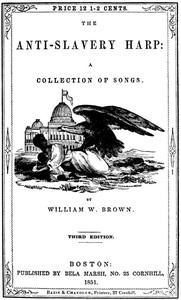
William Wells Brown's The Anti-slavery Harp (third edition, 1851) is a songbook designed for collective singing at anti-slavery meetings. Each lyric is headed by a tune name—'Air—Freedom's Banner,' 'Air—Araby's Daughter'—indicating that the words were meant to be sung to melodies already known to audiences. The compiler, a formerly enslaved author and activist, selected songs that move between lament, exhortation, and martial resolve. The opening piece, 'Freedom's Banner,' addresses the nation directly, contrasting the flag's ideal of liberty with the reality that it 'floats above three millions slaves.' This tension between patriotic symbol and abolitionist critique recurs throughout the collection.
Tunes as Political Vessels
The musical directions are not incidental. By specifying familiar airs—'Scots wha hae,' 'Kinloch of Kinloch'—Brown ensured that abolitionist arguments could be sung to tunes already associated with rebellion or sentiment. 'We're Coming, We're Coming,' set to 'Kinloch of Kinloch,' borrows the Scottish melody's martial character for lines like 'Our motto is FREEDOM, our country the world.' The pairing of new words with known music made the songs immediately usable at gatherings, turning a printed collection into a participatory tool. The third edition's Boston imprint (Bela Marsh) and the press of Bazin & Chandler suggest a network of radical publishing that supported such practical abolitionist materials.
The Recurring Figure of the Slave Mother
Several songs center on enslaved mothers, using their grief to indict the system. 'O, Pity the Slave Mother' imagines a woman 'careworn and weary' who 'sighs as she presses her babe to her breast,' knowing her children may be sold. The lyric insists that 'the grief of that mother can never be known,' a claim that both evokes sympathy and acknowledges the limits of representation. 'Lament of the Fugitive Slave' is more specific: its epigraph quotes Brown's own Narrative, and the speaker addresses a lost mother whose 'Roman-mother spirit' urged him to seek freedom. These songs do not simply sentimentalize motherhood; they use the mother-child bond to measure slavery's cruelty and to ground the demand for emancipation in intimate loss.
From Lament to Collective Action
The collection's emotional arc moves from sorrow to militant hope. Early songs dwell on suffering—'The mildew of slavery has blighted each blossom'—but later pieces shift to collective defiance. 'We're Coming, We're Coming' announces 'the fearless and free' who will 'put down' the 'man-stealing army.' 'On to Victory,' set to 'Scots wha hae,' declares 'We no earthly weapons wield, Light and love our sword and shield,' blending nonresistance with battle imagery. This progression suggests a deliberate ordering: the singer is led from pity to anger to action. The final excerpt, with its promise that 'the banner of Jesus will soon be unfurled,' ties abolition to Christian eschatology, offering a transcendent resolution to the temporal struggle.
Brown's Editorial Hand and the Third Edition
As compiler, Brown selected and arranged the songs, but the extent of his original authorship is unclear from the excerpts. The epigraph to 'Lament of the Fugitive Slave' quotes his own Narrative, placing his personal story within the songbook. The third edition's title page notes it is 'Compiled by William W. Brown,' a phrase that signals curation rather than sole authorship. The collection thus functions as a communal artifact, drawing on multiple voices—some named, some anonymous—to create a repertoire for movement use. Readers encountering the text today should note that the songs were meant to be heard and sung, not silently read; the musical directions are an invitation to performance, not mere decoration.
Because the excerpts represent only a portion of the forty-eight text sections, the full range of tunes and topics remains unknown. Readers may wish to compare the songs' assigned airs with the original melodies to understand how Brown adapted existing musical traditions. The collection rewards attention to its structure: the sequence from lament to mobilization, the repeated motifs of flags and mothers, and the strategic use of familiar tunes all reveal a carefully crafted tool for moral suasion and collective singing.
I found myself humming one of those militant tunes from Brown’s songbook the other day, struck by how a familiar melody could carry such a different weight. It made me recall the quiet way I once listened to Tschaikowsky’s orchestral pieces, hearing sorrow turn to resolve without a single word. Both left me with that ache of something deeply felt. Tschaikowsky and his orchestral music — Background and Themes sat beside me then, a gentler echo of the same mood.
Isaac Rivera
3 weeks agoSophia Lopez
3 weeks agoAvery Robinson
1 week agoLuke Martinez
3 weeks ago-
Jacob Kathleen Johnson - 3 weeks ago
This collection of songs is both historically significant and emotionally powerful. The lyrics capture the fervent spirit of the anti-slavery movement, making it a vital primary source for understanding social justice history. The melodies are simple enough for communal singing, and the messages remain relevant today. An inspiring and moving collection. -
David Zamora - 3 weeks ago
While the historical intent is noble, the musical quality of many songs is lacking, with simplistic melodies and repetitive lyrics. The presentation is bare-bones, and the context provided is minimal, making it hard for contemporary readers to fully engage. It's more of an artifact than a usable songbook. -
Jacob Blair - 1 week ago
The songs offer a valuable window into the abolitionist era, with heartfelt lyrics and historical importance. However, the musical notation may be challenging for modern readers, and some songs feel dated in their language. Still, it's a meaningful resource for historians and those interested in protest music.
How will you remember this book?
Save your reaction, strongest insight, and memorable passage.

Joseph Garcia
4 weeks ago