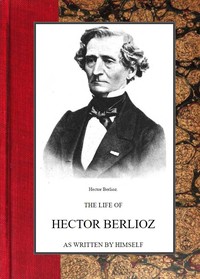
The life of Hector Berlioz as written by himself in his letters and memoirs — Background and Themes
Edition facts
The source record for The life of Hector Berlioz as written by himself in his letters and memoirs — Background and Themes measures this digital text at 94,234 words, 6 hr 50 min estimated reading time, and 15 detected text sections.
The text analysis averages about 16.4 words per sentence, while the detected sections provide another way to judge how the source is divided.
Project Gutenberg metadata also associates the work with “Composers -- France -- Biography,” connecting these edition facts with the source record’s subject description.
Calculated from edition completeness, EPUB availability, text structure and catalogue metadata. Not a user rating.
How this score is calculated
- Description quality20 pts
- Title & short description10 pts
- Source metadata20 pts
- Text length15 pts
- Chapters / structure15 pts
- EPUB file integrity20 pts
Total of 100 points, scaled to a 2.5-5.0 range. Editions with an empty description or a missing EPUB file are not scored.
Read the Text
und great difficulty in managing Adolph Adam, who was from Berlioz as the poles asunder.
First he went to Berlioz, who had flatly refused to make the slightest concession to Adam’s prejudices.
“Come,” said he, “do at least be amiable to Adam; you cannot deny that he is a musician, at any rate.”
“I don’t say he is not; but, being a great musician, how can he lower himself to comic-opera? If he chose he could _write such music as I do_.”
Undismayed, Alexandre went to Adam.
“You will give your vote to Berlioz, will you not, dear friend? Although you cannot appreciate each other, you will own that he is a thorough musician.”
“Certainly, he is a great musician, a really great one, but his music is awfully tiresome. Why!”--and little Adam straightened his spectacles--“why, if he chose he could compose ... as well as I do. But, seriously, he is a man of some importance, and I promise that, after Clapisson, who already has our votes, Berlioz shall have the next vacancy.”
By a strange coincidence, the next _fauteuil_ was Adam’s own, to which Berlioz was elected by nineteen votes.
In his weak state of health, Berlioz was quite unfit to face the innumerable worries incidental to the production of _The Trojans_. For seven years it had been his chief object in life, and if, as he said, he could have had everything requisite at his command, with unlimited capital to draw upon--as Wagner had with Louis of Bavaria--all might have been well. But to fight, contrive, temporise and propitiate all at once was more than his enfeebled frame and irascible spirit could stand.
Hence his great injustice to Carvalho, who, for Art’s sake, sacrificed money, time and reputation to an extent that crippled him for many years.
Embittered by the failure of his opera, which ran for about twenty-five nights, he shut himself up in his rooms with Madame Recio, his devoted mother-in-law, and an old servant, and from that time visited only a few intimate friends.
One last shock Fate held in store. Louis died of fever abroad, and for his lonely father life had no more savour--he simply existed, with, however, two last flashes of the old bright flame. One when, at Herbeck’s desire, he went to Vienna to conduct the _Damnation de Faust_, and the other when the Grand Duchess Helen prevailed on him to visit St Petersburg again.
That was the real end.
On leaving Russia he wandered drearily to Nice--a ghost revisiting its old-time haunts--then made one last appearance at Grenoble, and so the flame went out. He who had never peace in life was at rest at last.
Of his music this is not the place to speak. He has fully described his own ideas, others have analysed them, and we are now concerned with the man himself.
To this is due the somewhat disjointed form of the translation--the mixture of Memoir and Letters. It seemed the only possible way of showing Berlioz in all his aspects and of keeping the record chronologically correct.
Yet we could wish that he, who had so much affinity with England and its literature, could meet with due appreciation here.
He has founded no school (in spite of Krebs’ prophecy), unless the “programme music” now so much in vogue can be traced back to him, but, beginning with Wagner, every orchestral composer since his day owes him a debt of gratitude for his discoveries--his daring and original combinations of instruments, and his magnificent grouping and handling of vast bodies of executants.
1803. Louis Hector Berlioz born.
1822. Medical student in Paris.
1824. Mass failed at Saint-Roch under Masson.
1825. Mass succeeded.
1826. Failed in preliminary examination for Conservatoire competition.
1827. Passed preliminary and entered for competition. His _Orpheus_ declared unplayable.
1828. Third attempt. _Tancred_ obtained second prize. Saw Miss Smithson. Gave first concert.
1829. Fourth attempt. _Cleopatra._ No first prize given.
1830. Gained Prix de Rome with _Sardanapalus_. Marie Pleyel.
1831. Rome. _Symphonie Fantastique_ and _Lélio_.
1832. Concert at which Miss Smithson present on 9th December.
1833. Marriage. In November Henriette’s benefit and failure.
1834. Louis born. _Harold_ performed in November.
1835. _Symphonie Funèbre_ begun.
1837. _Benvenuto Cellini_ finished.
1838. Paganini’s present.
1839. _Romeo and Juliet._
1840. _Funèbre_ performed. First journey to Brussels.
1841. Festival at Paris Opera House.
1842-3. First tour in Germany.
1844. _Carnaval Romain._ Gigantic concert in the Palais de l’Industrie. Nice.
1845. Cirque des Champs Elysées concert. Marseilles. Lyons. Austria.
1846. Hungary. Bohemia. In December, failure of _Damnation de Faust_.
1847. Russia. Berlin. In November, London, as conductor at Drury Lane.
1848. London. In July, Paris. Death of Dr Berlioz.
1849. _Te Deum_ begun.
1850. _Childhood of Christ_ begun.
1851. Member of Jury at London Exhibition.
Berlioz's self-portrait, assembled from his letters and memoirs, is a study in controlled fury. He writes not to confess but to correct, aiming to silence the false versions of his life then in circulation. The result is a narrative that bristles with indignation, yet also with moments of startling candor. His description of newspaper criticism as a task that 'poisons my life' and his longing to 'toast' his detractors on a gridiron reveal a man for whom artistic integrity was a matter of visceral, almost physical, pain.
A Voice of Uncompromising Temper
The Berlioz who speaks in these pages is rarely temperate. He describes his hatred of 'circumlocution, diplomacy, trimming, and all half-measures and concessions' with a vehemence that makes plain his refusal to play the courtier. This is not the posture of a memoirist seeking sympathy; it is the ingrained habit of a man who measured the world against his own exacting standards. When he recounts the failure of his opera Benvenuto Cellini, he does not spare himself—he admits he 'stupidly concluded' that the subject would interest others—but he also refuses to concede that the work was inferior. The rehearsal scenes, with the conductor Habeneck breaking his bow in a rage, are rendered with a novelist's eye for detail: the dragging tempo of the saltarello, the dancers' complaints, Berlioz's own cold retort. These passages do more than document a professional setback; they dramatize a collision between two kinds of authority—the institutional and the creative.
The Weight of Patronage and Poverty
Berlioz's account of his financial struggles is laced with a bitterness that never quite curdles into self-pity. He notes, almost offhandedly, that the post of librarian at the Conservatoire brought him '118 francs a month'—a sum that underscores the precariousness of his existence. The narrative is punctuated by interventions from well-placed friends: Victor Hugo saved his librarianship, Charles Blanc helped him repeatedly. Yet Berlioz presents these as isolated acts of kindness in a system otherwise indifferent or hostile. His description of the opera management's attitude—'they looked upon me as a species of lunatic'—suggests a man acutely aware of how he was perceived, even as he refused to modify his behavior. The tension between his need for patronage and his loathing of compromise gives these passages a particular edge.
The Translator's Framing
Katharine F. Boult's introduction sets the terms for reading the volume. She acknowledges that autobiography is 'open to the charge of egoism' but argues that in a genius, self-belief is not conceit. More pointedly, she observes that the Memoir alone is not a satisfactory character-study; it is the Letters that reveal Berlioz's 'very real heroism,' and then 'quite unconsciously.' This editorial framing invites the reader to attend to what the text does not say directly—to read between the lines of Berlioz's self-justifications. Boult's characterization of the Autobiography's protagonist as 'music-ridden, brutal, undisciplined' and 'more a blind, unreasoning force of Nature than an ordinary being' is striking in its frankness. It prepares the reader for a narrative that is less a confession than a performance of defiance.
Recurring Motifs of Conflict
Certain patterns recur across the excerpts: Berlioz at odds with conductors, with critics, with the very machinery of musical production. The scene at the Opera, where Habeneck deliberately drags the tempo, is echoed by a later triumph when Berlioz conducts the same saltarello without rehearsal and brings it off perfectly. These episodes form a kind of moral geometry, in which the composer's integrity is tested and vindicated. His hatred of criticism is not merely professional pique; it is rooted in a conviction that the critic's role is inherently corrupting. 'I abominate criticism,' he writes, 'and feel quite ill from the moment I see the advertisement of a new performance until I have written my article on it.' The physicality of the reaction—the illness, the poison—is characteristic. Berlioz does not merely dislike his work; it sickens him.
The Shape of the Narrative
The chapter titles trace an arc from provincial childhood ('La Côte Saint-André') to late-career retrospect ('The Afterglow,' 'Darkness and Light'). Along the way, landmarks include encounters with Weber, Liszt, Mendelssohn, and Wagner, as well as the composition of major works like the Requiem and The Trojans. But the excerpts suggest that Berlioz is less interested in chronicling his compositions than in dramatizing the obstacles to their performance. The memoir is structured around a series of battles—with Cherubini, with Habeneck, with the Opera management—each recounted with a mixture of outrage and grim satisfaction. The reader is left with the impression of a life lived in a state of permanent siege, relieved only by occasional, hard-won victories.
Readers should approach this volume as a curated self-portrait, not a neutral record. Berlioz's voice is unmistakable—passionate, sarcastic, wounded—but the silences are equally telling. The translator's introduction warns that the Memoir omits much that the Letters reveal. To read this book is to watch a man construct his own legend, brick by bitter brick, and to decide for oneself where the truth lies.
Reading Berlioz’s self-account, I recall sitting with my grandfather’s old biography of Schubert, the one where the boy’s quiet poverty felt unbearably close to his music’s warmth. Both men gave everything to sound, and both letters stirred that same ache—genius carried in ordinary hands. Franz Schubert : The Story of the Boy Who Wrote Beautiful Songs — Edition Insights felt that way too.

There are no reviews for this eBook.
Your personal reading reflection
Build a private reading journal entry for this title.