About 21 minutes
Mozart : The story of a little boy and his sister who gave concerts — Text and Context
Composers
4,705 recorded words. 1 minutes difference from this book's estimate.
View Gutenberg source #34582
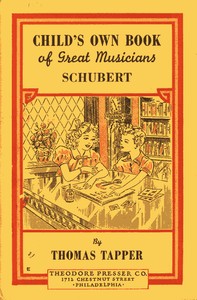
The catalog record for Franz Schubert : The Story of the Boy Who Wrote Beautiful Songs — Edition Insights provides practical reading context through 4,977 words, 22 min estimated reading time, and 1 detected text section.
The text analysis averages about 19.1 words per sentence, while the detected sections provide another way to judge how the source is divided.
Project Gutenberg metadata also associates the work with “Composers -- Austria -- Biography -- Juvenile literature,” connecting these edition facts with the source record’s subject description.
Explore this collection
These alternatives are selected using recorded categories and estimated reading time.
About 21 minutes
Composers
4,705 recorded words. 1 minutes difference from this book's estimate.
View Gutenberg source #34582About 24 minutes
Composers
5,494 recorded words. 2 minutes difference from this book's estimate.
View Gutenberg source #34737About 24 minutes
Composers
5,332 recorded words. 2 minutes difference from this book's estimate.
View Gutenberg source #35128Search stored excerpts and compare books → Choose by your preferences →
Choices use stored catalog measurements. Estimates vary with reading speed. A shared category is a catalog label, not a claim that two books have the same argument or literary quality.
Search reads excerpt text stored with this catalog and links to its associated Gutenberg record. The connection is stored in the site database; this tool does not recheck that every excerpt is word-for-word identical to that external record. Excerpt search does not cover every chapter and does not verify historical publication dates.
Catalog snapshot checked: 2026-09-26. Coverage: 98 public books, 98 available source excerpts.
Calculated from edition completeness, EPUB availability, text structure and catalogue metadata. Not a user rating.
Total of 100 points, scaled to a 2.5-5.0 range. Editions with an empty description or a missing EPUB file are not scored.
Public-domain source text
The source text is kept in the dedicated reader, separate from this catalogue record and its commentary.
Thomas Tapper's 1916 biography of Franz Schubert is not a conventional read. It belongs to the Child's Own Book of Great Musicians series, designed as a cut-and-paste activity book. Children are instructed to cut apart illustrations, paste them into numbered spaces, and later write their own story of the composer on blank pages. The book is then sewn together with a cord. This format makes the biography a physical project as much as a narrative.
The text itself is brief and direct, opening with the claim that Schubert 'was born with a spring of melody in his heart and a song on his lips.' It includes musical notation for songs like 'Trout' and 'Wandering,' inviting the child to listen or play. The book's structure—part factual account, part workbook—reflects an educational philosophy that learning happens through doing.
The book's physical design is its most distinctive feature. The instructions tell the child to 'cut apart' the sheet of illustrations, 'paste' each into its numbered space, and 'sew' the book through the center with a cord. This transforms the biography into a craft project. The child is not merely reading about Schubert but assembling the book itself.
The text is interspersed with musical excerpts—staff notation for 'Trout' and 'Wandering'—and direct questions: 'Listen. Play it or have someone play it to you. Is it not worth remembering all one's life?' These moments break the narrative flow, turning the page into a prompt for active engagement. The book ends with blank pages for the child to 'write his own story of the great musician, based on the facts and questions found on the previous pages.'
This approach suggests that the author, Thomas Tapper, valued ownership and participation. The child becomes a co-creator of the book, not just a reader. The biography is thus a vehicle for a larger pedagogical goal: making the facts of a composer's life personally meaningful through manual and reflective work.
Tapper's prose consistently ties Schubert's identity to melody. The opening line declares he 'was born with a spring of melody in his heart and a song on his lips.' The text repeatedly asks the child to consider the beauty of specific songs: 'Can anyone make a melody more lovely than this?' from 'Trout,' and 'Is not this a jolly one?' from 'Wandering.'
The explanation for Schubert's global popularity is simple: 'just because he never let a song come from his lips that did not first come from his heart.' This phrase links the composer's emotional sincerity to his musical output. The narrative does not dwell on technical skill or historical context; instead, it presents Schubert as a natural, almost effortless creator of song.
The excerpts also include a description of Schubert's birthplace in Vienna—'a very simple house that looks quite old-fashioned'—with a bust and a sign. This detail grounds the abstract idea of 'melody' in a specific, humble location. The book's focus remains on the songs themselves, not on biography in a conventional sense. The child is encouraged to listen, play, and remember, making the music the primary subject.
The book's structure is built around interactive prompts. The child is told: 'Dates are easy to remember if we write them. So you must ask your teacher when Schubert was born and put in the date in the next sentence.' This turns a simple fact into a research task. The text does not provide the birth year directly; it expects the child to find it.
Similarly, the narrative includes blank spaces for the child to fill in. The sentence 'Franz Schubert was born in.......' is left incomplete. This pattern recurs throughout: the book supplies a framework, but the child supplies the specific information. The final blank pages are for 'his own story,' based on 'the facts and questions found on the previous pages.'
This method implies that learning is an active, social process. The child must ask the teacher, write, cut, paste, and eventually synthesize. The biography is not a finished product but a starting point. Tapper's series, which includes volumes on Bach, Beethoven, Mozart, and others, standardizes this approach across multiple composers, making each book part of a larger educational system.
Readers approaching this book should expect a hybrid experience: part biography, part craft kit. The text is minimal and direct, but the activities—cutting, pasting, writing—are central. To get the most from it, follow the instructions literally: listen to the musical excerpts, fill in the blanks, and write your own summary. The book's value lies not in its depth of biographical detail but in its method of making the child an active participant in learning about Schubert's life and songs.
There is a particular sweetness in watching a young Schubert find his song, as Tapper’s little book shows us, and it always reminds me of another composer, one who carried his own private ache into every letter. That quiet kinship of sorrow and melody lives on in The Life & Letters of Peter Ilich Tchaikovsky — Story, Setting & Ideas, where feeling, too, becomes music.
A brief reflection can help important ideas stay with you longer.