About 80 minutes
Terpander; or, Music and the future — Reading Companion
Music History
18,263 recorded words. 14 minutes difference from this book's estimate.
View Gutenberg source #76559
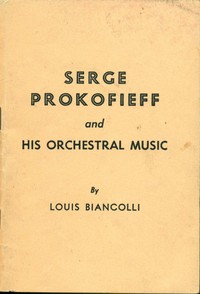
The source record for Serge Prokofieff and his orchestral music — A Reader’s Guide measures this digital text at 21,499 words, 1 hr 34 min estimated reading time, and 3 detected text sections.
The text analysis averages about 20.2 words per sentence, while the detected sections provide another way to judge how the source is divided.
Project Gutenberg metadata also associates the work with “Prokofiev, Sergey, 1891-1953,” connecting these edition facts with the source record’s subject description.
Explore this collection
These alternatives are selected using recorded categories and estimated reading time.
About 80 minutes
Music History
18,263 recorded words. 14 minutes difference from this book's estimate.
View Gutenberg source #76559About 73 minutes
Music History
16,687 recorded words. 21 minutes difference from this book's estimate.
View Gutenberg source #50230About 115 minutes
Music History
26,385 recorded words. 21 minutes difference from this book's estimate.
View Gutenberg source #73127Search stored excerpts and compare books → Choose by your preferences →
Choices use stored catalog measurements. Estimates vary with reading speed. A shared category is a catalog label, not a claim that two books have the same argument or literary quality.
Search reads excerpt text stored with this catalog and links to its associated Gutenberg record. The connection is stored in the site database; this tool does not recheck that every excerpt is word-for-word identical to that external record. Excerpt search does not cover every chapter and does not verify historical publication dates.
Catalog snapshot checked: 2026-09-26. Coverage: 98 public books, 98 available source excerpts.
Calculated from edition completeness, EPUB availability, text structure and catalogue metadata. Not a user rating.
Total of 100 points, scaled to a 2.5-5.0 range. Editions with an empty description or a missing EPUB file are not scored.
Public-domain source text
The source text is kept in the dedicated reader, separate from this catalogue record and its commentary.
Louis Biancolli opens his study of Prokofieff's orchestral music by reprinting the composer's own 'Creed,' a four-part classification of his creative lines: classical, innovation, toccata or motor element, and lyrical. Prokofieff explicitly rejects 'grotesque' as a label, preferring 'Scherzo-ness' with gradations of 'Jest,' 'laughter,' and 'mockery.' This framework, rather than a chronological biography, structures the book's approach. Biancolli, a New York music critic and author of The Analytical Concert Guide, wrote the volume for radio members of the Philharmonic-Symphony Society of New York, a context that shapes its tone and assumed audience.
The book's most distinctive feature is its reliance on Prokofieff's self-analysis. The composer's 'Creed' is presented verbatim, dividing his output into four lines: classical (including neo-classical works like the Classical Symphony), innovation (from early harmonic experiments to Scythian Suite and The Gambler), toccata or motor element (citing Schumann's influence), and lyrical (which Prokofieff claims was long overlooked). Biancolli uses these categories as chapter headings, organizing discussions of individual works under them. This structure means the book is less a chronological survey than a thematic taxonomy, one that privileges the composer's own voice over external critical judgments. The excerpts show Biancolli quoting Prokofieff extensively, including an interview where the composer describes his method: 'I am always on the lookout for new melodic themes. These I write in a notebook, as they come to me, for future use.'
Biancolli devotes substantial space to the Fifth Piano Concerto, reproducing Prokofieff's own movement-by-movement analysis from a Boston Transcript interview. Prokofieff emphasizes that the work is 'entirely on the melodic,' with five movements containing at least four themes each, yet the entire concerto lasts 'over twenty minutes.' He insists there is 'actual development of the themes, but this development is as compressed and condensed as possible.' The composer explicitly denies a program and rejects the term 'march' for the second movement, cautioning against 'vulgarity or commonness.' Biancolli then juxtaposes this 'mild and dispassionate self-appraisal' with the 'slashing commentary' of Soviet biographer Nestyev, who describes the toccata as having 'bold jumps, hand-crossing, and Scarlatti technic in highly exaggerated form' and 'monstrous extremes.' This contrast—between Prokofieff's measured technical description and Nestyev's ideological critique—reveals the book's layered perspective.
Biancolli does not present himself as an original analyst but as a compiler and interpreter of Prokofieff's own statements and contemporary criticism. The excerpts show him quoting the composer at length, including a description of the Fifth Concerto's structure: 'The piano always has the leading part which is closely interwoven with significant music in the orchestra.' He also includes Nestyev's hostile Soviet reading, which condemns the 'machine-like Toccata' as 'athletic' and 'acrobatic.' This editorial choice gives the book a documentary quality, allowing readers to compare Prokofieff's self-image with external reception. The dedication to 'Radio Members of the Philharmonic-Symphony Society of New York' suggests an audience of concertgoers seeking program-note-level insight, not specialists. Biancolli's prose is clear and unobtrusive, letting the composer's voice dominate.
Readers should approach this book as a curated collection of primary sources—Prokofieff's own classifications, interviews, and contemporary reviews—rather than a comprehensive biography. Biancolli's framework of the four creative lines provides a useful entry point, but the excerpts are incomplete; the full text likely covers more works and includes additional critical voices. The book's value lies in its preservation of Prokofieff's own analytical language, which offers a rare glimpse into how the composer understood his own music.
There’s something touching in how Biancolli preserves Prokofieff’s own quiet pride in his “five lines” of composition, as if the music itself were a personal diary. It reminds me of an old companion on my shelf, Shakespeare and Music — Edition Insights, which lingers on similar private connections between a maker and their craft. Strange, how these scholarly guides become like letters from another era.
Your answers remain private and are stored only in this browser.