About 73 minutes
Tschaikowsky and his orchestral music — Background and Themes
Music History
16,687 recorded words. 7 minutes difference from this book's estimate.
View Gutenberg source #50230
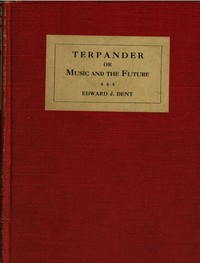
For Terpander; or, Music and the future — Reading Companion, the stored edition analysis reports 18,263 words, 1 hr 20 min estimated reading time, and 18 detected text sections.
The text analysis averages about 25.7 words per sentence, while the detected sections provide another way to judge how the source is divided.
Project Gutenberg metadata also associates the work with “Music -- Philosophy and aesthetics,” connecting these edition facts with the source record’s subject description.
Explore this collection
These alternatives are selected using recorded categories and estimated reading time.
About 73 minutes
Music History
16,687 recorded words. 7 minutes difference from this book's estimate.
View Gutenberg source #50230About 71 minutes
Music History
16,231 recorded words. 9 minutes difference from this book's estimate.
View Gutenberg source #26427About 68 minutes
Music History
15,581 recorded words. 12 minutes difference from this book's estimate.
View Gutenberg source #69856Search stored excerpts and compare books → Choose by your preferences →
Choices use stored catalog measurements. Estimates vary with reading speed. A shared category is a catalog label, not a claim that two books have the same argument or literary quality.
Search reads excerpt text stored with this catalog and links to its associated Gutenberg record. The connection is stored in the site database; this tool does not recheck that every excerpt is word-for-word identical to that external record. Excerpt search does not cover every chapter and does not verify historical publication dates.
Catalog snapshot checked: 2026-09-26. Coverage: 98 public books, 98 available source excerpts.
Calculated from edition completeness, EPUB availability, text structure and catalogue metadata. Not a user rating.
Total of 100 points, scaled to a 2.5-5.0 range. Editions with an empty description or a missing EPUB file are not scored.
Public-domain source text
The source text is kept in the dedicated reader, separate from this catalogue record and its commentary.
The book opens with an anecdote about an elderly musician emerging from a Debussy concert and declaring he is glad he will not live to hear the 'music of the future.' Dent uses this vignette to frame a central tension: the gap between listeners who find modern music a 'succession of hideous noises' and those who, despite little pleasure, study it with 'passionate interest and curiosity.' The title figure, Terpander—an ancient Greek musician who added strings to the lyre and was fined for innovation—serves as a historical parallel for the discomfort that accompanies musical change. Dent does not promise a defense of modernism, but instead explores why the music of his own time feels so alien, comparing the experience to learning a language with 'no connection with the Indo-European stock.'
Dent argues that the difficulty of contemporary music is not merely a matter of unfamiliar sounds but of an entirely new syntax. He likens the listener's predicament to mastering a language whose grammar and vocabulary bear no resemblance to any known tongue. The 'student of modern music' is made sceptical by the fact that respected musicians among the initiates seem to speak this language fluently, yet the ordinary listener cannot find even a 'faint hope of being able to understand it.' This framing shifts the debate from taste to cognition: the issue is not whether the music is good or bad, but whether it can be comprehended at all. Dent avoids taking sides, instead presenting the problem as a genuine intellectual puzzle.
Dent traces the roots of modern musical discontent to the nineteenth century, which he calls 'the age of the amateur pianist.' He critiques the 'endless flood of polite and agreeable music' produced for domestic consumption, and the rise of 'characteristic pieces'—hunting songs, spinning songs, barcarolles—that became 'universally recognizable conventions.' While acknowledging the genuine merits of Mendelssohn and Schumann, Dent argues that their style degenerated into 'a multitude of insincere clichés' in the hands of followers. He singles out Gustav Mahler's symphonies as the 'apotheosis' of romantic cliché, and notes that ethical fervour among later composers led to 'reverent pomposity.' The pianoforte, he claims, was the ideal vehicle for this diffusion, its percussive action exaggerating rhythmical stresses and its sound unable to 'press onwards' like a voice or violin.
Dent observes that much nineteenth-century music relies on the emotional effect of large groups performing in unison. He cites Handel as the ideal composer for national ceremony, and notes that the 'communal feeling' behind such music finds 'technical expression in blocks of chords and in strongly accentuated rhythms.' The finale of Beethoven's Fifth Symphony is given as a typical example. Dent is critical of this tendency when it becomes a trick, as in Liszt, whose pianistic style favoured full chords over contrapuntal complexity. Yet he also acknowledges the power of 'several hundred people doing exactly the same thing at one moment,' a phenomenon he compares to military and gymnastic displays. This observation ties the aesthetic of massed sound to broader social and psychological currents, without reducing music to mere sociology.
Dent's essay is best approached as a series of provocations rather than a systematic treatise. Readers will find no definitive answer to the question of music's future, but a thoughtful exploration of why that question feels so urgent. The excerpts suggest that Dent is as interested in the psychology of listening as in the technical evolution of composition. Pay attention to his recurring metaphors of language and translation, and to his willingness to criticize both conservative and progressive camps. The book rewards those who read it as a period piece—a snapshot of musical anxiety in the 1920s—rather than a prophecy.
That rain kept drumming on the windows while I sat with Terpander, Dent’s dry wit about the pianoforte somehow warming the gray afternoon. Later, idly shelving books, I pulled down something about American musical life, Reflections on the Music Life in the United States — Inside the Classic, and found the same quiet question—how we hear what is new—waiting there too.
Your answers remain private and are stored only in this browser.