About 637 minutes
Frederick Chopin, as a Man and Musician — Volume 2 — Reading Notes
Composers
146,457 recorded words. 505 minutes difference from this book's estimate.
View Gutenberg source #4972
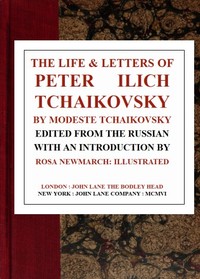
Before opening The Life & Letters of Peter Ilich Tchaikovsky — Story, Setting & Ideas, the edition data offers a quick orientation: 262,454 words, 19 hr 2 min estimated reading time, and 39 detected text sections.
The text analysis averages about 16.9 words per sentence, while the detected sections provide another way to judge how the source is divided.
Project Gutenberg metadata also associates the work with “Composers -- Russia -- Biography,” connecting these edition facts with the source record’s subject description.
Explore this collection
These alternatives are selected using recorded categories and estimated reading time.
About 637 minutes
Composers
146,457 recorded words. 505 minutes difference from this book's estimate.
View Gutenberg source #4972About 598 minutes
Composers
137,416 recorded words. 544 minutes difference from this book's estimate.
View Gutenberg source #54968About 590 minutes
Composers
135,672 recorded words. 552 minutes difference from this book's estimate.
View Gutenberg source #57570Search stored excerpts and compare books → Choose by your preferences →
Choices use stored catalog measurements. Estimates vary with reading speed. A shared category is a catalog label, not a claim that two books have the same argument or literary quality.
Search reads excerpt text stored with this catalog and links to its associated Gutenberg record. The connection is stored in the site database; this tool does not recheck that every excerpt is word-for-word identical to that external record. Excerpt search does not cover every chapter and does not verify historical publication dates.
Catalog snapshot checked: 2026-09-26. Coverage: 98 public books, 98 available source excerpts.
Calculated from edition completeness, EPUB availability, text structure and catalogue metadata. Not a user rating.
Total of 100 points, scaled to a 2.5-5.0 range. Editions with an empty description or a missing EPUB file are not scored.
Public-domain source text
The source text is kept in the dedicated reader, separate from this catalogue record and its commentary.
Modeste Tchaikovsky's authorized biography of his brother, translated by Rosa Newmarch, is structured as a hybrid of memoir and epistolary record. The narrative voice shifts between the biographer's third-person commentary and the composer's own letters, creating a layered portrait of Tchaikovsky's inner life. The excerpts show how the book moves from broad biographical framing—such as the translator's justification of abridgments—to intimate, first-person accounts of rehearsals, travel, and emotional states. This alternation of perspectives gives the reader direct access to Tchaikovsky's voice while maintaining editorial distance.
Modeste Tchaikovsky occupies a unique position as both sibling and chronicler. The text reveals his presence primarily through the selection and arrangement of letters, yet his own voice emerges in transitional passages that contextualize events. For instance, after quoting a letter about the Maid of Orleans rehearsals, Modeste adds: “The production … left a very unpleasant memory in Tchaikovsky’s mind.” This editorial gloss does not merely summarize; it interprets the emotional residue of the experience. The biographer also notes his brother's sensitivity to criticism, observing that “his artistic vanity was exceedingly sensitive, even when his best friends told him ‘the plain truth.’” Such remarks blend affection with frankness, a tone that distinguishes this work from a purely documentary collection.
Tchaikovsky's letters are rich with sensory detail and abrupt shifts in mood. Writing from Florence in 1881, he exclaims: “What light! What sunshine! … I feel so well, and yet so sad—I could weep.” The juxtaposition of delight and melancholy is characteristic. His correspondence also records practical frustrations: the difficulty of finding a dress-coat on a Sunday in Rome, or the intrigues of opera officials. These details ground the emotional highs and lows in concrete circumstances. The letters are not merely artistic statements; they are dispatches from a life constantly in motion—between St. Petersburg, Italy, and the composer's own fluctuating spirits.
The excerpts show how the biography handles public failure. After the premiere of The Maid of Orleans, Tchaikovsky reports being “recalled twenty-four times.” Yet a telegram soon informs him that the press deems the opera “poor in inspiration, wearisome, and monotonous.” The narrative does not linger on this contradiction; instead, it moves quickly to the next letter, from Rome. The effect is to let the composer's resilience—or perhaps his avoidance—speak for itself. The biographer notes that Cui “led the chorus of unfavourable opinion,” but offers no rebuttal. This restraint leaves the reader to weigh the public verdict against the private triumph of the premiere.
Readers approaching this biography should attend to the interplay between Modeste's framing and the raw letters. The book's pace quickens during travel sequences and slows for artistic setbacks, mirroring Tchaikovsky's own rhythms. Because the excerpts cover only portions of the composer's life, the full arc of his career must be inferred from the selected correspondence. The index of works and names at the end provides a useful reference for tracking recurring figures and compositions across the seven parts.
There are moments in Modeste's pages—reading Tchaikovsky's own hand about a theme that won't settle—that feel less like biography and more like sitting beside someone working it out. It stays with you. I found that same quiet absorption in Wagner : The Story of the Boy Who Wrote Little Plays — Key Ideas to Explore, where the struggle begins earlier, in a boy's first attempts, and somehow that made the older composer's letters feel even nearer.
Answer a few questions and save a private reflection on this device.