About 24 minutes
Beethoven : The story of a little boy who was forced to practice — A Reader’s Guide
Composers
5,494 recorded words. 0 minutes difference from this book's estimate.
View Gutenberg source #34737
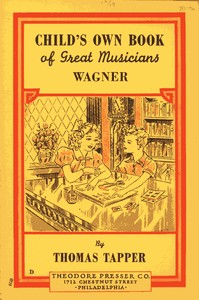
For Wagner : The Story of the Boy Who Wrote Little Plays — Key Ideas to Explore, the stored edition analysis reports 5,332 words, 24 min estimated reading time, and 1 detected text section.
The text analysis averages about 19.0 words per sentence, while the detected sections provide another way to judge how the source is divided.
Project Gutenberg metadata also associates the work with “Composers -- Germany -- Biography -- Juvenile literature,” connecting these edition facts with the source record’s subject description.
Explore this collection
These alternatives are selected using recorded categories and estimated reading time.
About 24 minutes
Composers
5,494 recorded words. 0 minutes difference from this book's estimate.
View Gutenberg source #34737About 25 minutes
Composers
5,521 recorded words. 1 minutes difference from this book's estimate.
View Gutenberg source #35013About 22 minutes
Composers
4,977 recorded words. 2 minutes difference from this book's estimate.
View Gutenberg source #35070Search stored excerpts and compare books → Choose by your preferences →
Choices use stored catalog measurements. Estimates vary with reading speed. A shared category is a catalog label, not a claim that two books have the same argument or literary quality.
Search reads excerpt text stored with this catalog and links to its associated Gutenberg record. The connection is stored in the site database; this tool does not recheck that every excerpt is word-for-word identical to that external record. Excerpt search does not cover every chapter and does not verify historical publication dates.
Catalog snapshot checked: 2026-09-26. Coverage: 98 public books, 98 available source excerpts.
Calculated from edition completeness, EPUB availability, text structure and catalogue metadata. Not a user rating.
Total of 100 points, scaled to a 2.5-5.0 range. Editions with an empty description or a missing EPUB file are not scored.
Public-domain source text
The source text is kept in the dedicated reader, separate from this catalogue record and its commentary.
The book opens not with a musical prodigy but with a boy who wrote little plays. Thomas Tapper's 1918 biography for children introduces Richard Wagner as a child whose first creative impulses were dramatic, not musical. The narrative begins in Leipzig, at a house called the Red and White Lion, where Wagner was born on May 22, 1813. Tapper emphasizes the boy's early habit of composing plays, a detail that frames his later operatic work as an extension of childhood storytelling. The biography is part of the Child's Own Book of Great Musicians series, designed to be cut, pasted, and sewn by the child reader—a physical engagement that mirrors the active, hands-on approach to learning about the composer.
Tapper begins with an odd detail: Wagner's birthplace was a house named the Red and White Lion. The author notes that no one ever saw a red and white lion, yet that was the name. This whimsical fact sets a tone of curiosity and invites the child reader to imagine the unusual. The house stands in Leipzig, a Saxon city described as quaint and old. Tapper uses this setting to ground Wagner's origins in a specific, tangible place. The description is brief but vivid, suggesting that the composer's life began in a world where names could be fanciful and imagination was welcome. This opening strategy—starting with a concrete, slightly odd fact—reflects the book's method of making history accessible through memorable details.
The title of the book itself points to a key tension: Wagner is remembered as a composer, but Tapper focuses on his early playwriting. The excerpts show that the narrative emphasizes Wagner's childhood habit of writing little plays, a detail that recurs throughout. This choice suggests that Tapper wants young readers to see creativity as a broad impulse, not limited to music. The book implies that Wagner's operas grew from a dramatic instinct, not just a musical one. By foregrounding the plays, Tapper frames Wagner's later work as an extension of childhood make-believe. This approach also aligns with the interactive nature of the book: the child reader is encouraged to write their own story at the end, becoming a creator like Wagner.
The book is not meant to be read passively. Tapper's series includes a sheet of illustrations to be cut apart and pasted into designated spaces. The instructions specify using photographic paste and placing the pictures neatly within printed lines. After this, the child writes their own story of the musician on blank pages, based on facts and questions from the book. Finally, the child sews the book together with a cord and needle provided in an envelope. This physical process turns the biography into a craft project. The book becomes the child's own, literally assembled by hand. This method teaches facts through doing, and it reflects an educational philosophy that values active engagement over mere reading.
Readers should approach this book as both a biography and a hands-on activity. The cut-and-paste illustrations and the blank pages for the child's own story are integral to the experience. Tapper's focus on Wagner's childhood playwriting offers a fresh angle for young readers, who may not yet know the composer's music. The book invites them to see creativity as a process that begins with simple acts of imagination—writing a little play, cutting out a picture, sewing a book. It is a portrait of the artist as a young boy, and a prompt for the child reader to become one too.
Reading about young Wagner drafting his little plays, I found myself thinking of another child at a piano, chasing melodies in the air. Both boys seemed to carry a private world inside them, waiting for quiet moments to let it out. That gentle persistence reminds me of Chopin : The Story of the Boy Who Made Beautiful Melodies — Key Ideas to Explore, somehow, that old book holds the same soft, patient wonder.
Create a short personal record of your experience with this book.