About 24 minutes
Beethoven : The story of a little boy who was forced to practice — A Reader’s Guide
Composers
5,494 recorded words. 1 minutes difference from this book's estimate.
View Gutenberg source #34737
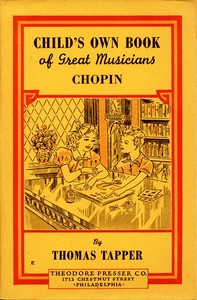
The catalog record for Chopin : The Story of the Boy Who Made Beautiful Melodies — Key Ideas to Explore provides practical reading context through 5,521 words, 25 min estimated reading time, and 1 detected text section.
The text analysis averages about 18.8 words per sentence, while the detected sections provide another way to judge how the source is divided.
Project Gutenberg metadata also associates the work with “Chopin, Frédéric, 1810-1849 -- Juvenile literature,” connecting these edition facts with the source record’s subject description.
Explore this collection
These alternatives are selected using recorded categories and estimated reading time.
About 24 minutes
Composers
5,494 recorded words. 1 minutes difference from this book's estimate.
View Gutenberg source #34737About 24 minutes
Composers
5,332 recorded words. 1 minutes difference from this book's estimate.
View Gutenberg source #35128About 22 minutes
Composers
4,977 recorded words. 3 minutes difference from this book's estimate.
View Gutenberg source #35070Search stored excerpts and compare books → Choose by your preferences →
Choices use stored catalog measurements. Estimates vary with reading speed. A shared category is a catalog label, not a claim that two books have the same argument or literary quality.
Search reads excerpt text stored with this catalog and links to its associated Gutenberg record. The connection is stored in the site database; this tool does not recheck that every excerpt is word-for-word identical to that external record. Excerpt search does not cover every chapter and does not verify historical publication dates.
Catalog snapshot checked: 2026-09-26. Coverage: 98 public books, 98 available source excerpts.
Calculated from edition completeness, EPUB availability, text structure and catalogue metadata. Not a user rating.
Total of 100 points, scaled to a 2.5-5.0 range. Editions with an empty description or a missing EPUB file are not scored.
Public-domain source text
The source text is kept in the dedicated reader, separate from this catalogue record and its commentary.
Thomas Tapper's Chopin: The Story of the Boy Who Made Beautiful Melodies (1917) is not a conventional biography. It belongs to the Child's Own Book of Great Musicians series, designed as a craft project: children cut out illustrations, paste them into designated spaces, and sew the pages together with a provided cord. The text itself is brief and direct, addressing the reader with questions such as “In what country he was born” and “What kinds of music he composed.” The opening lines promise that “as long as we live and keep in touch with the works of the great composers we shall love more and more the music of Frederic François Chopin,” establishing a tone of gentle reverence. The narrative quickly anchors Chopin in a specific place: “a little village in Poland not far from the City of Warsaw, beside which flows the famous river Vistula.” This geographic detail, paired with a picture of the birth house, grounds the story in a concrete setting.
The most striking feature of this volume is its physical interactivity. The publisher, Theodore Presser Co., included a needle and cord for the child to bind the book after pasting in illustrations. Directions explain: “Start in from the outside as shown on the diagram here. Pass the needle and thread through the center of the book, leaving an end extend outside.” This process transforms reading into a tactile activity. The book also contains blank pages “upon which the child is to write his own story of the great musician, based upon the facts and questions found on the previous pages.” Tapper thus positions the child as both reader and creator. The format implies that learning about Chopin is not passive absorption but an act of construction—literally sewing together facts and images. This pedagogical choice reflects early twentieth-century educational trends that valued manual work and self-expression.
Tapper's prose relies heavily on interrogative sentences to guide the young reader. Early in the text, he lists three questions: “In what country he was born. In what places he lived. What kinds of music he composed.” These are not rhetorical; they function as a study outline. Later, the book includes numbered questions such as “Name some of the kinds of music that Chopin composed?” (the excerpt notes a correction where a question mark was changed to a period). The language is simple and declarative: “Perhaps we may begin by learning that he was born in a little village in Poland.” The author avoids complex sentences or abstract descriptions. Instead, he presents facts as answers to implied queries. This structure mirrors a classroom recitation, where the teacher prompts and the student responds. The questions also serve as a mnemonic device, helping children retain key details about Chopin's life and work.
The narrative immediately situates Chopin in a specific landscape: “a little village in Poland not far from the City of Warsaw, beside which flows the famous river Vistula.” This sentence does more than state a birthplace; it evokes a region through the river's name. The text then references “a picture of the house in which Chopin was born,” indicating that the printed page and the pasted illustration work together. The series includes a sheet of illustrations to be cut apart and inserted “in its proper place throughout the book, pasted in the space containing the same number.” This numbering system ensures that the child matches image to text. By combining verbal description with a physical image, Tapper reinforces geographical and biographical facts. The river Vistula, the village near Warsaw, and the house become touchstones that the child can see and handle.
Tapper's authorial voice is warm but instructional. He writes, “It will be pleasant to learn from time to time something about him.” The word “pleasant” suggests that learning should be enjoyable, not laborious. He addresses the child directly, using “we” to create a shared journey: “We should like, for example, to know.” This inclusive pronoun softens the didactic tone. The book's subtitle, “The Story of the Boy Who Made Beautiful Melodies,” frames Chopin as a child like the reader, emphasizing his early creativity. Tapper avoids dramatic anecdotes or emotional appeals; the narrative remains factual and calm. The closing pages include blank sheets for the child's own composition, reinforcing the idea that the child can emulate Chopin by writing a story. The overall effect is that of a patient tutor guiding a pupil through a structured but friendly lesson.
Tapper's book is best approached as a period artifact of music education. Its value lies not in biographical depth but in its method: it asks the child to physically assemble the story while answering factual questions. Readers today might note how the text's simplicity and the craft component reflect early twentieth-century assumptions about childhood learning. The book invites comparison with modern interactive media, yet its reliance on paper, paste, and thread offers a distinctly analog experience. For those interested in the history of children's literature or music pedagogy, this volume provides a concrete example of how one author sought to make a composer's life tangible.
Reading about Chopin’s childhood—how that little book has you sew its pages together—left me thinking about how we hold onto early melodies. I felt the same quiet wondering when I later lingered over The Great German Composers — A Reader’s Guide. It’s simply another way of remembering, softly, that music starts as a small, patient longing.
Use these questions to collect your thoughts before moving on.