About 22 minutes
Franz Schubert : The Story of the Boy Who Wrote Beautiful Songs — Edition Insights
Composers
4,977 recorded words. 1 minutes difference from this book's estimate.
View Gutenberg source #35070
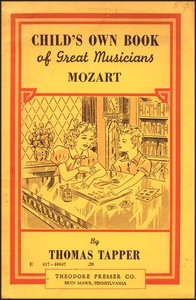
Mozart : The story of a little boy and his sister who gave concerts — Text and Context can be approached with a clearer sense of reading commitment from its source measurements: 4,705 words, 21 min estimated reading time, and 1 detected text section.
The text analysis averages about 19.1 words per sentence, while the detected sections provide another way to judge how the source is divided.
Project Gutenberg metadata also associates the work with “Mozart, Wolfgang Amadeus, 1756-1791 -- Juvenile literature,” connecting these edition facts with the source record’s subject description.
Explore this collection
These alternatives are selected using recorded categories and estimated reading time.
About 22 minutes
Composers
4,977 recorded words. 1 minutes difference from this book's estimate.
View Gutenberg source #35070About 24 minutes
Composers
5,494 recorded words. 3 minutes difference from this book's estimate.
View Gutenberg source #34737About 24 minutes
Composers
5,332 recorded words. 3 minutes difference from this book's estimate.
View Gutenberg source #35128Search stored excerpts and compare books → Choose by your preferences →
Choices use stored catalog measurements. Estimates vary with reading speed. A shared category is a catalog label, not a claim that two books have the same argument or literary quality.
Search reads excerpt text stored with this catalog and links to its associated Gutenberg record. The connection is stored in the site database; this tool does not recheck that every excerpt is word-for-word identical to that external record. Excerpt search does not cover every chapter and does not verify historical publication dates.
Catalog snapshot checked: 2026-09-26. Coverage: 98 public books, 98 available source excerpts.
Calculated from edition completeness, EPUB availability, text structure and catalogue metadata. Not a user rating.
Total of 100 points, scaled to a 2.5-5.0 range. Editions with an empty description or a missing EPUB file are not scored.
Public-domain source text
The source text is kept in the dedicated reader, separate from this catalogue record and its commentary.
Thomas Tapper's 1915 biography of Wolfgang Amadeus Mozart adopts a notably intimate and affectionate register from its opening lines, referring to the composer as "Wolferl" and his sister Maria Anna as "Nannerl." This diminutive naming immediately establishes a familial, storybook atmosphere that persists throughout the text. The narrative voice is direct and conversational, frequently addressing the reader with phrases like "Here is a picture of one" and "And here is a picture of Wolferl trying to reach the keys." Such interjections, combined with the inclusion of illustrations referenced in the prose, create a hybrid reading experience that blends biographical storytelling with a guided tour of visual aids. The author's choice to foreground the children's nicknames and domestic scenes—such as the three-year-old Wolferl listening to Nannerl's lessons—signals that this account prioritizes the human, playful dimensions of Mozart's childhood over formal historical exposition.
The text immediately distinguishes itself through its use of informal nicknames: Wolfgang is "Wolferl" and his sister is "Nannerl." This choice is not merely decorative; it shapes the reader's perception of the young prodigies as relatable children rather than remote historical figures. The narrative consistently emphasizes the family unit, describing how "Father Mozart loved both of his children deeply and often played with them." The father's role as teacher is highlighted through scenes of daily violin lessons and family trio performances, where "Papa Mozart, who was a very fine player on the violin" joins Wolferl and Nannerl at the piano. By framing Mozart's early musical education within these warm domestic vignettes, Tapper constructs a biography that feels less like a formal chronicle and more like a family album brought to life through words.
Despite the storybook tone, Tapper repeatedly underscores the young Mozart's remarkable discipline. When Wolferl began lessons at age four, "while he practised no one ever spoke to him because he was so serious about it." This detail—the enforced silence during practice—conveys the intensity of the child's focus. The narrative also notes that when other children came to play with Nannerl, Wolferl would "make music for their games and marching; playing in strict time all the while." The phrase "strict time" is a precise musical observation that hints at his innate rhythmic precision. These passages balance the affectionate framing with evidence of the rigorous work ethic that underpinned his early fame, offering readers a nuanced portrait of a prodigy who was both a playful child and a dedicated musician.
The biography's pacing shifts noticeably when it describes the family's concert tours. The early sections dwell on domestic scenes with a leisurely, descriptive rhythm, but the narrative accelerates once Wolferl reaches nearly six years old: "his father took him and Nannerl on a concert tour. Everybody wanted to hear them play and they gave many concerts." The repetition of "many" and the swift movement from Salzburg to Paris and London create a sense of momentum. The text notes that "Wolferl spent all his boyhood with his music" and that the children "were happy to play because they loved the music so much." This compression of time and geography mirrors the whirlwind experience of a touring child performer, while the consistent emphasis on the siblings' joy maintains the upbeat, admiring tone that characterizes the entire work.
Readers approaching this biography should attend to how Tapper's narrative voice—alternately cozy and brisk—shapes the portrayal of Mozart's childhood. The text's reliance on nicknames, illustrations, and familial scenes invites a sentimental reading, but the recurring details about the child's serious practice habits and the rapid tour schedule complicate any purely idyllic interpretation. This tension between domestic warmth and professional rigor is the book's most distinctive feature, offering a compact but layered introduction to the young musician's world.
That little Wolferl, practicing scales while Nannerl turned pages, reminds me how often greatness blooms quietly beside another soul. The same gentle hand that guided Salzburg’s prodigy seems to linger over Haydn’s patient craft. I have often shelved them together, these two old friends, sensing they would smile at each other’s company. There is a humbling warmth in that thought. Haydn — Inside the Classic holds that same dear familiarity.
Use these questions to collect your thoughts before moving on.