About 60 minutes
Deems Taylor — Key Ideas to Explore
Composers
13,733 recorded words. 16 minutes difference from this book's estimate.
View Gutenberg source #70244
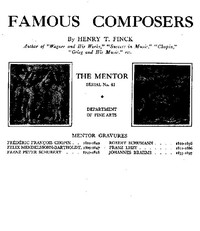
The catalog record for The Mentor: Famous Composers, Vol. 1, Num. 41, Serial No. 41 — Reading Companion provides practical reading context through 9,980 words, 44 min estimated reading time, and 7 detected text sections.
The text analysis averages about 20.9 words per sentence, while the detected sections provide another way to judge how the source is divided.
Project Gutenberg metadata also associates the work with “Composers,” connecting these edition facts with the source record’s subject description.
Explore this collection
These alternatives are selected using recorded categories and estimated reading time.
About 60 minutes
Composers
13,733 recorded words. 16 minutes difference from this book's estimate.
View Gutenberg source #70244About 25 minutes
Composers
5,521 recorded words. 19 minutes difference from this book's estimate.
View Gutenberg source #35013About 24 minutes
Composers
5,494 recorded words. 20 minutes difference from this book's estimate.
View Gutenberg source #34737Search stored excerpts and compare books → Choose by your preferences →
Choices use stored catalog measurements. Estimates vary with reading speed. A shared category is a catalog label, not a claim that two books have the same argument or literary quality.
Search reads excerpt text stored with this catalog and links to its associated Gutenberg record. The connection is stored in the site database; this tool does not recheck that every excerpt is word-for-word identical to that external record. Excerpt search does not cover every chapter and does not verify historical publication dates.
Catalog snapshot checked: 2026-09-26. Coverage: 98 public books, 98 available source excerpts.
Calculated from edition completeness, EPUB availability, text structure and catalogue metadata. Not a user rating.
Total of 100 points, scaled to a 2.5-5.0 range. Editions with an empty description or a missing EPUB file are not scored.
Public-domain source text
The source text is kept in the dedicated reader, separate from this catalogue record and its commentary.
The Mentor issue on famous composers opens with a striking claim: Poland, not Italy or Germany, revolutionized piano music. Henry T. Finck immediately foregrounds Chopin as the embodiment of this revolution, describing him as “the soul of the piano” and tracing the Polish roots of his polonaises and mazurkas. The text blends national identity with musical form, arguing that Chopin’s pieces unite “the raciness of the soil with the qualities of his own creative genius.”
Finck’s method is to pair biographical anecdote with evaluative commentary. In the Mendelssohn monograph, he highlights the composer’s astonishing productivity at age eleven—sixty pieces in one year—and the famous recovery of a lost score from memory. The Schubert section, by contrast, stresses the composer’s lack of formal instruction, framing his career as a story of “gloom and sorrow.” These contrasts in origin, training, and temperament shape the issue’s underlying argument about genius and national character.
Finck repeatedly uses national origin to explain compositional style. In the Chopin section, he insists that despite French accents in the composer’s name, Chopin was “as thoroughly Polish in all his sympathies as his mother.” The polonaises and mazurkas are presented as hybrids of aristocratic ceremony and folk dance, “artistically blended” to create a new kind of piano music. Finck even compares this fusion to Luther Burbank’s hybrid fruits, a period-specific analogy that underscores his view of Chopin as a cultivator of musical forms.
The Mendelssohn monograph takes a different tack: here, nationality is less about folk roots than about institutional prestige. Mendelssohn’s appointment at the Gewandhaus in Leipzig is called “the highest honor in the German music world.” His career is mapped through a series of European capitals—Berlin, Paris, London—and his ten trips to England are noted as a mark of international success. Finck does not claim that Mendelssohn’s music is German in the same way Chopin’s is Polish; instead, he presents the composer as a cosmopolitan figure whose wealth and connections enabled a remarkably active life.
Finck’s biographies are structured around output and its physical toll. Mendelssohn’s early feats—sixty pieces in his first year of composition, a three-act opera by age fifteen, and the completion of A Midsummer Night’s Dream at seventeen—are recounted without critical analysis of the works themselves. The narrative then shifts to overwork: “The worry of his Berlin duties… began to wear on his health.” The final paragraphs describe a collapse upon hearing of his sister Fanny’s death, followed by a brief recovery and sudden death at forty-eight.
Schubert’s trajectory is even starker. Finck notes that he “had the least instruction of any” great master and that his life was “full of the gloom and sorrow.” The contrast with Mendelssohn’s privileged upbringing is implicit but sharp. Where Mendelssohn’s activity is framed as remarkable, Schubert’s is framed as a struggle against circumstance. Finck does not dwell on specific compositions in either case; the focus remains on the arc of the career and the price of creative labor.
The issue is part of a series called The Mentor, and its editorial apparatus shapes how the biographies are read. Each composer section is labeled a “Monograph Number…” in “The Mentor Reading Course,” suggesting that the text was designed for self-education. The language is declarative and often superlative: Paderewski is “the greatest pianist of our time,” Chopin is “greatest of all the Poles.” These judgments are presented as fact, not opinion.
Finck also uses analogies that date the text. Chopin’s blend of folk and aristocratic elements is likened to “Luther Burbank’s wonderful new fruits,” a reference that would have been current in 1913 but now signals the issue’s historical distance. The prose is efficient, moving from birth to death in a few paragraphs per composer, with little attention to musical technique or reception. The result is a set of portraits that prioritize narrative clarity over depth, reflecting the Mentor Association’s goal of accessible cultural education.
Readers should approach this issue as a historical document of early twentieth-century music appreciation. Finck’s judgments—on Polish piano supremacy, on Mendelssohn’s genius, on Schubert’s pathos—reflect the tastes and assumptions of 1913. The biographies are compressed and evaluative, not analytical. To understand the music itself, one must look beyond the text to the works mentioned. But as a record of how these composers were presented to a general audience, the issue offers a clear, period-specific lens on canon formation.
I keep thinking about that old Mentor volume, how Finck lingered on Schubert's untutored genius, as if formal training could never touch what he had. It made me wonder about the other composers we never got to meet there. There's a quiet companion, Famous composers and their works, Vol. 1 — Reading Companion, that feels like a continuation of that same gentle conversation, filling in some of the silences.
Build a private reading journal entry for this title.